Understanding the Concept of MTG Cube

So you’re knee-deep in Magic: The Gathering, weaving spells and summoning creatures like it’s your job. But let’s face it, even the most thrilling duels can eventually turn as bland as yesterday’s oatmeal. Suddenly, you’re stuck in a Groundhog Day loop predicting every move your opponents make. And poof, there goes the whole “randomness” thing the game’s built on. Bummer, right? Well, wipe that tear away, because guess what? There’s a hero to save the day!

Enter the stage with jazz hands: the MTG cube format! It’s like giving your card battles a fresh coat of paint. Imagine this: you and your buddies gather a whopping 360 cards, enough to make a librarian green with envy. And the best part? It’s not a solo gig anymore. You can round up to 8 eager players. Now, 8 might sound like trying to fit a circus troupe in a Mini Cooper, but fear not! The mystical interwebs have your back. You can cube it up online, transcending space and time zones like a digital sorcerer.

So there you have it, the ultimate solution to turning your Magic nights into a rotating carnival of spells and surprises. Gather your cards, call up your pals, or just wrangle some virtual wizards, and dive into the cube-licious world of MTG cube gaming.

What is MTG Cube?
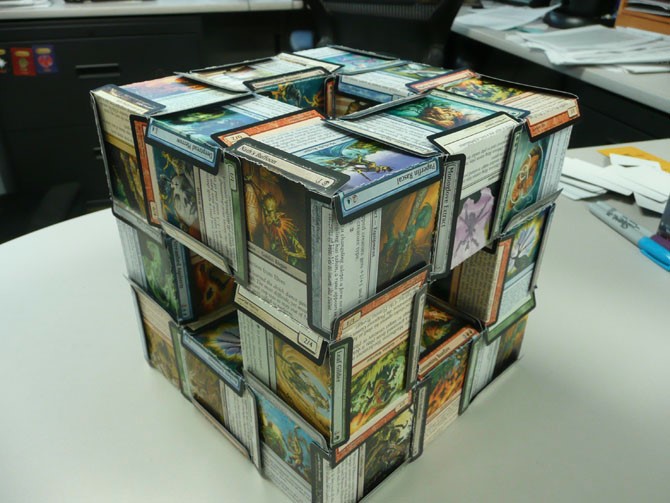
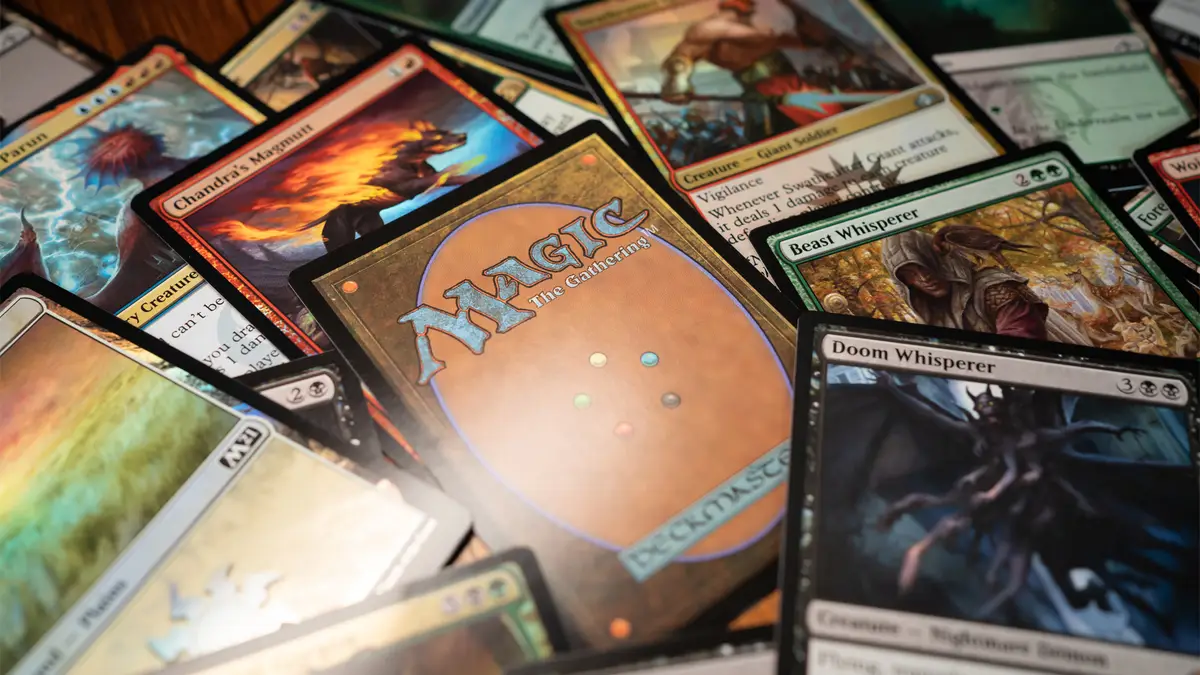
Alrighty, let’s dive into the world of MTG cube like we’re spelunking for treasure in a card-filled cave. Brace yourselves, because this format is like a magical flea market on steroids. You can pile up between 360 and 720 cards, which is like inviting a whole horde of cards to a rager. And the basic setup of 360 cards is like throwing together 24 boosters of 15 cards each. Gather around 8 pals, and boom, you’ve got a card party.

Now, here’s the kicker: you can’t have a clone club in your cube. Each card needs to be a one-of-a-kind superstar. It’s like a high-stakes game of “Guess Who?” where every card is a character with its own quirks.

With this card buffet, the game gets wilder than a roller coaster in a hurricane. You never know what’s gonna pop up next, and that’s the magic of it.

Building a Cube is like playing matchmaker for your favorite cards that don’t quite fit into the regular deck dating scene. Each MTG Cube is like a fingerprint, unique to its creator. It’s a way to show off your personality – it’s like dressing up your cards for a glamorous ball. You can go all out with fancy foil versions or flaunt promo cards like they’re red carpet VIPs. Heck, you can even sneak in cards autographed by their artists – talk about a collector’s flex.

Read Also: How To Maximize Your EDH Deck Strength

How to Create an MTG Cube

So, you’re about to embark on a journey into the mystical world of crafting and maintaining a Cube in Magic: The Gathering. Buckle up, because here’s the lowdown in a few easy-peasy steps:

Step 1: Get Your Theme and Size Sorted

First things first, decide how big you want your Cube to be. It’s like picking the size of your canvas for an epic painting. Then, channel your inner wizard and figure out what kind of cards and strategies you’re vibing with. Are you all about summoning creatures left and right, flinging spells like a spell-flinging pro, or just chilling in the lands department? This is your card kingdom, after all!

Step 2: Round Up Your Cards

Time to rustle up those cards, partner! You can snag ’em in all sorts of ways – buying, trading, or unleashing cards from your own collection like a magician revealing their deck of secrets. Just remember, variety is the spice of Cube life. Make sure you’ve got creatures, spells, lands, and all that jazz for a well-balanced card stew.

Step 3: Card Categorization Fiesta

Next up, it’s like sorting your sock drawer, but way more magical. Organize your cards into categories or themes, making it easier to play mix-and-match later on. And hey, why not make a fancy list of your cards? You know, with their names, colors, and all the deets. It’s like giving your Cube a virtual name tag.

Step 4: Cube Construction Time

Now comes the fun part – deciding which cards make the cut. Think of it as crafting a fantasy sports team, but with cards. Use tools like card databases and Cube lists to pick and choose your card champions. Balance is key, like a perfectly made sandwich. And if you’re feeling a particular vibe or strategy, give it a high-five in your Cube.

Step 5: Game On, Cube Style

Congratulations, you’ve built your Cube masterpiece! Time to give it a whirl and see how it performs. Play some games with your friends, your imaginary friends, or even your pet rock – whatever floats your card boat. If things are flowing smoothly, you’re golden. If not, no worries! Tweak and adjust like a master chef refining their recipe.

Step 6: Keepin’ it Fresh

Like a houseplant or a favorite pair of jeans, your Cube needs some love and attention over time. Stay in the loop about new card releases and any rule changes that could throw a curveball into your Cube universe. And if you’re itching for a change, switch things up based on your own card cravings or your pals’ thoughts. Give your Cube a spa day every now and then – it deserves it.

There you have it, your Cube saga from start to finish. Now go forth and create a card collection that’s more enchanting than a unicorn riding a rainbow!

Reasons Why You Should Play in a Cube Draft

So, you might be sitting there, pondering whether diving into the whole cube-building adventure is your kind of jam.

Here’s the scoop – it’s like asking if pineapple belongs on pizza; opinions vary, my friend. But let’s say you rounded up a bunch of players, put a spotlight on them, and asked, “Is cube-drafting worth the hype?” Odds are, you’d get a chorus of “Oh heck yeah!”

Imagine this: you’re in a card duel with your pals, and that one friend – let’s call them the “Constant Victor” – seems to have a hotline to card luck. A cube could be your magical solution, a potion to stir things up and give everyone a fighting chance. It’s like serving a curveball to a cricket team that’s used to home runs.

And oh boy, the themes you can rustle up in a cube! Picture this: a cube themed like a disco party, complete with glittery cards and spell beats that’ll make you want to boogie. Or maybe you go old-school with a Power Nine cube, where the cards are like the superhero legends of Magic: The Gathering, cape and all.

Let’s talk socializing, shall we? Cubes are the ultimate party trick for game nights. It’s like throwing a card carnival where up to eight players can dive into the chaos. And remember, in the world of cubes, randomness is the guest of honor and wild Magic combos are the party favors.

Feeling fancy and ready to splurge on a card-shopping spree? Grab a whole booster box and shower yourself with a confetti of new cards. Just be sure to catch those falling cards – paper cuts are not part of the package deal.

So there you have it, my fellow adventurer into the cube realm. Is it worth it? Heck yeah, but remember, it’s your journey, your deck, and your magical kingdom to rule.

Conclusion

In a world where every card flip and every strategy is a ticket to a new adventure, the MTG Cube shines as a beacon of creativity, camaraderie, and boundless fun. Crafting your very own cube is like being a mad scientist in a lab of cards, concocting a unique universe of gameplay that aligns perfectly with your preferences and style. With the power to turn the tables on predictable victories and introduce exhilarating surprises, a cube breathes fresh life into Magic: The Gathering gatherings.
The Mystery of Permanents in Magic: The Gathering

Ahoy there, fellow planeswalkers and spell-slingers! Gather ’round as we embark on a mystical journey through the enchanting realms of Magic: The Gathering. Today, our focus shall illuminate the enigmatic world of “Permanents” – those sneaky, steadfast cards that stick around like your favorite sidekick.

Picture this: you’re a master conjurer, a sorcery slinger, and you’re holding your deck close to your heart. Your fingers dance over the cards like a maestro composing an arcane symphony. And what’s this? A permanent card winks at you from your hand. But what is it? Why, it’s a card that’s here to stay, like that friend who always overstays their welcome but in a good way!

So, what in the multiverse are Permanents, you ask? Buckle up, because we’re diving into the rabbit hole!

The Defining Essence of Permanents

In the mystical realm of Magic: The Gathering, Permanents are cards that take the concept of “here to stay” to a whole new plane. These are the trusty companions that stick around like that one stubborn mosquito at your summer campfire. They’re like the furniture of your deck – steadfast, unwavering, and integral to the tapestry of your game.

See Also: Beginners Guide To Power Levels in EDH

Types of Permanents: A Mixed Bag of Magic

Now, here’s where things get spicy! Permanents come in various flavors, each with its own unique charm. Let’s lift the curtain and unveil the grand gallery of these mystic marvels:

1. Creatures

These are the creatures of myth and lore, brought to life on your card table. From the fearsome dragons that can scorch your opponent’s plans to the nimble faeries that can evade even the craftiest of traps, creatures are the heart and soul of your battlefield strategy.

2. Artifacts

Ever wished you could hold the power of a relic from ancient times? Artifacts are your ticket to that dream. These nifty gadgets can range from an enchanting amulet that boosts your spells to a towering contraption that can change the tide of battle.

3. Enchantments

Ah, the sweet melodies of enchantments! These cards are like the whispers of unseen spirits, bestowing your game with unique abilities and a touch of the fantastical. Whether it’s a land that blossoms with otherworldly magic or a curse that plagues your foes, enchantments are the spice of life in the world of Magic.

4. Lands

Now, don’t be fooled – lands might seem like mere bits of cardboard, but they hold the very essence of the planes you traverse. They’re the bedrock of your strategy, the foundation upon which your spells are woven. From the serene plains to the untamed forests, lands are the tapestry of your battlefield.

5. Planeswalkers

Ever wanted to pal around with Jace or Chandra? Planeswalkers are the VIPs of your deck – powerful beings who’ve seen more planes than your luggage at an interplanar airport. These walking legends add a dash of personal flair to your game, casting spells, summoning creatures, and even messing with the minds of your opponents.

The Dance of Permanents: Unveiling the Symphony

Now that we’ve unveiled the colorful cast of Permanents, let’s talk about their dance on the battlefield. When you cast a permanent card, it waltzes onto the battlefield, ready to rock and roll. Creatures stand tall, ready to clash in an epic showdown, while enchantments lend their enchanting aura to the scene. Artifacts hum with latent power, and lands… well, they just do their thing, patiently waiting for you to tap into their magic.

But, dear planeswalker, remember this: every dance has its rhythm, and Permanents have their own tempo. You’ll need to tap your lands just right to summon these magical companions, and once they’re out, they’re here to stay – until some cunning spell or a strategically-placed axe sends them packing.

Conclusion

So, there you have it, a glimpse into the vibrant realm of Permanents in Magic: The Gathering. These cards are more than just cardboard cutouts; they’re the threads that weave your strategy, the companions that stand by your side, and the heartbeats of your deck.

Next time you lay out your cards and take on the role of a planeswalker, remember the Permanents that stay. Creatures, artifacts, enchantments, lands, and planeswalkers – they’re the symphony that turns a simple game into a magical journey through the multiverse. So shuffle your deck, draw your cards, and may your Permanents always be in your favor!

Beginners Guide to Rampage in Magic The Gathering

Hey there, fellow Planeswalkers! Today, we’re gonna explore a thrilling mechanic in MTG that’ll have you stomping, roaring, and causing some serious mayhem on the battlefield – it’s time to talk about Rampage!

What is Rampage?

So, what exactly is Rampage, you ask? In MTG lingo, Rampage is a good ol’ mechanic that hails from the bygone era of Legends, the expansion set that defined a whole new realm of imagination and magic. Born in the ancient year of 1994, Rampage is a keyword ability that showcases the raw power and untamed spirit of the creatures it blesses.

At its core, Rampage is all about getting stronger the more opposition it faces. Think of it as a creature’s primal determination to prove its worth and might. The more foes it has in its way, the more it grows in strength, smashing through blockers and leaving a trail of destruction behind.

Rampage in Action

Imagine you’re summoning a mighty dragon onto the battlefield. A creature with Rampage 3, for instance. This means that for each creature blocking the dragon, it gets +3/+3. Now, that’s some serious firepower! It’s as if the dragon is challenging its adversaries to come at it, only to emerge even fiercer in the midst of the chaos.

One of the coolest aspects of Rampage is that it perfectly embodies the spirit of MTG – adaptability and unpredictability. The mechanic may not be as prevalent as it once was, but when it shows up, you can bet it leaves a lasting impact. It keeps players on their toes, reminding us that there’s always something new to discover, even in the older sets of the game.

Exploring the Beasts of Rampage

Now, let’s delve into the heart of the Rampage mechanic and explore some of the wildest and most magnificent creatures to have ever graced the MTG universe.

1. Sivitri Scarzam

This legendary creature from Legends was one of the first to wield the power of Rampage. With Rampage 2, she embraces the “go big or go home” philosophy, growing even stronger with each challenger. Not to mention, her wickedly cool name adds an extra layer of allure to her card.

2. Lhurgoyf

This iconic beast is like the poster child for Rampage. From the classic Ice Age expansion, Lhurgoyf is a force of nature. Its power and toughness are equal to the number of creatures in all graveyards combined! So, the more carnage, the merrier!

3. Archery Training

Oh, so you thought Rampage was just for creatures? Think again! Archery Training, also from Legends, is an enchantment that gifts creatures you control with the ability to shoot an arrow at attackers, dealing them 1 damage for each attacking creature. It’s like having a troop of skilled archers ready to strike!

4. Tornado Elemental

Journeying into more modern territory, Tornado Elemental from Commander 2014 is a perfect example of the Rampage mechanic’s ongoing allure. With a Rampage of 2, this elemental powerhouse will blow away your opponent’s defenses, leaving their battlefield in ruins.

5. Xenagos, God of Revels

Not to be outdone, the infamous Planeswalker, Xenagos, embraces the Rampage spirit in the Theros expansion. His +X/+X ability grants a creature trample and bonus power, making him the life of the party that boosts your other creatures to legendary proportions.

6. Ulasht, the Hate Seed

Ravnica, City of Guilds, introduced us to this colossal elemental Hydra. With Rampage 1, Ulasht gleefully punishes your opponent’s blockers while also allowing you to populate for double the trouble!

Embrace the Rampage: Unleash the Beast Within

While Rampage may not be the most omnipresent mechanic in MTG, it brings a sense of nostalgia and awe-inspiring moments to the game. It showcases the designers’ creative prowess, instilling a sense of untamed nature in the world of magic.

Conclusion

Whether you’re a seasoned Planeswalker or just starting your journey into the MTG multiverse, experimenting with Rampage can be a wild and adrenaline-pumping experience. Watching your creatures grow stronger with each challenge feels like unleashing the fury of nature itself on your opponents.

So, as you traverse the vast planes of Magic: The Gathering, remember the thrill of the Rampage mechanic. Embrace the chaos, let your creatures roar, and revel in the untamed might that Rampage brings to your decks. Unleash the beast within and leave your opponents trembling before the unstoppable force of your Rampaging army!

May your battles be epic, your victories glorious, and your Rampage relentless! Happy gaming, fellow Planeswalkers!

How Many Players Are Recommended In a Commander Game?

Commander, also known as Elder Dragon Highlander (EDH), is a popular multiplayer format in the Magic: The Gathering trading card game. In Commander, players build decks around a legendary creature, known as their commander, and compete against each other in a unique and exciting gameplay experience. One crucial aspect to consider when playing Commander is the recommended number of players. This article will explore the factors to consider when determining the optimal player count for a Commander game.

What is Commander?

Commander is a format that emphasizes multiplayer interactions, politics, and deckbuilding creativity. Each player starts with 40 life points and uses a deck of exactly 100 cards, including their chosen commander. The commander is a legendary creature card that remains separate from the deck and can be cast from a special zone known as the command zone. Commander games typically involve three or more players, making it a social and engaging format.

The Importance of Player Count

The number of players in a Commander game significantly impacts the overall gameplay experience. With more players, there are increased opportunities for diplomacy, politics, and interactive gameplay. On the other hand, fewer players may result in a faster-paced and more focused game. It is essential to strike the right balance to ensure an enjoyable and engaging Commander session.

Optimal Number of Players

Determining the optimal number of players for a Commander game depends on several factors. Let’s explore them in detail:

1. Game Balance

Commander games thrive on achieving a delicate balance between all participants. Too few players can lead to a lack of diversity in gameplay and strategies, while too many players may result in chaos and longer game durations. Striking a balance between having enough opponents to keep the game interesting and not overcrowding the battlefield is crucial.

2. Length of the Game

The number of players directly influences the duration of a Commander game. Generally, more players tend to extend the game length. If you prefer longer, epic battles with complex board states and intricate interactions, a larger player count might be suitable. However, if you prefer quicker and more streamlined games, a smaller player count may be more appropriate.

3. Social Interaction

Commander is renowned for its social interaction and politics between players. With more players involved, there are increased opportunities for diplomacy, negotiation, and forming alliances. The social aspect adds depth and excitement to the gameplay, making a larger player count favorable for those who enjoy the interactive elements of Commander.

4. Personal Preference

Personal preference plays a significant role in determining the ideal player count for a Commander game. Some players may thrive in larger multiplayer games, relishing the chaotic and unpredictable nature of battles involving numerous opponents. Others may prefer the intimacy of smaller games, allowing for deeper strategic planning and quicker decision-making.

5. Available Resources

The available resources, such as space, time, and the number of available players, should be considered when determining the player count for a Commander game. If you have limited space or time constraints, it may be more practical to opt for a smaller player count. However, if you have a dedicated playgroup or a larger gaming space, accommodating more players can enhance the overall experience.

Player Count Recommendations

Based on the factors discussed, here are some general player count recommendations for Commander games:

  • 3 players: This player count offers a balanced experience with sufficient social interaction and reasonable game length. It is ideal for those seeking a quicker Commander game without sacrificing the interactive elements.
  • 4 players: The most common player count in Commander, a four-player game strikes a good balance between game length, strategic depth, and social dynamics. It allows for diverse gameplay and engaging interactions among participants.
  • 5+ players: Larger playgroups can create a lively and dynamic environment, with intense political maneuvering and unpredictable outcomes. These games often feature longer durations and require careful management of resources and strategies.

Ultimately, the ideal player count for a Commander game depends on the preferences of the players involved and the specific context of each gaming session. Experimentation with different player counts can help determine what works best for your playgroup.

Conclusion

Determining the recommended number of players for a Commander game involves considering various factors such as game balance, length, social interaction, personal preference, and available resources. While three to five players are the most common options, it is essential to find the player count that provides an enjoyable and engaging experience for all participants. Whether you prefer a quicker duel or a grand multiplayer spectacle, Commander offers a versatile format suitable for a range of player counts.

FAQs

What happens if I play Commander with only two players?

While Commander games can be played with just two players, the format is primarily designed for multiplayer interactions. Playing with two players may result in a less diverse and interactive gameplay experience. However, it can still be enjoyable if both players are open to adapting strategies and embracing a different dynamic.

Can I play Commander with more than six players?

While Commander games can accommodate more than six players, managing a larger group can become challenging. With more participants, the game may take significantly longer, and interactions can become more complex. It is recommended to have a clear plan for turn order and maintain open communication to ensure a smooth gaming experience.

Are there any alternative formats for Commander with specific player counts?

Yes, there are alternative formats designed specifically for different player counts. For example, Two-Headed Giant is a variant of Commander where teams of two players each compete against each other. This format works best with an even number of players.

Is there an official Commander rule regarding player count?

The official rules of Commander do not prescribe a specific player count. It is a flexible format that can be adapted to various player counts, as long as the players agree on the parameters before the game begins.

Can I play Commander with just one opponent?

While it is possible to play Commander with just one opponent, the format is optimized for multiplayer interactions. Playing with a single opponent may result in a different dynamic and potentially reduce the diversity of gameplay strategies. It is recommended to discuss and agree on house rules or adjustments to ensure an enjoyable experience.

What Makes MTG Commander Different From Other Formats

Magic: The Gathering is a popular collectible card game that has captured the hearts of millions of players around the world. With its rich lore, strategic gameplay, and vast card pool, Magic offers a variety of formats for players to enjoy. One such format that has gained immense popularity is Commander. In this article, we will delve into what Magic: The Gathering Commander is all about and explore how it differs from other formats.

Reasons Why MTG Commander Is Different From The Rest

Magic: The Gathering or MTG Commander, also known as Elder Dragon Highlander (EDH), is a multiplayer format where each player starts with a deck consisting of 100 cards, including a legendary creature as their commander. The goal of the game is to reduce your opponents’ life total to zero, but Commander introduces unique rules and deck construction restrictions that make the format distinct from others.

Deck Construction Rules

In Commander, players must adhere to specific deck construction rules, including:

  • Each deck must contain exactly 100 cards, including the commander.
  • Except for basic lands, players cannot include more than one copy of each card in their deck.

These rules encourage diversity and ensure that no two decks are the same.

Singleton Format

The Singleton format is a defining characteristic of Commander. It means that players can only include one copy of each non-basic land card in their deck. This creates a dynamic gameplay experience, where players are forced to think strategically and make the most out of their limited resources. The Singleton format adds an element of surprise and unpredictability to each game.

Commander Selection

The commander serves as the focal point of the deck and influences the entire gameplay. Players choose a legendary creature card to be their commander, and it starts the game in a special zone called the command zone. Key points regarding commander selection include:

  • Players can cast their commander from the command zone.
  • If the commander is removed from the battlefield, it can be sent back to the command zone instead of the graveyard.
  • The commander determines the color identity of the deck, restricting the inclusion of cards to match the commander’s color identity.

Unique Deckbuilding Restrictions

Commander introduces additional deckbuilding restrictions, such as:

  • The deck must consist of cards that fall within the color identity of the commander.
  • For example, if the commander is a red and green creature, the deck can only contain cards that are red, green, or both.

These restrictions encourage players to explore different color combinations and build decks that synergize well with their commander’s abilities.

Increased Deck Size

Compared to other Magic formats, Commander decks have an increased deck size of 100 cards. This larger deck size allows for more variety and increases the likelihood of drawing unique cards during a game. It also necessitates careful deck construction to ensure a balanced mix of spells, creatures, and other necessary components.

Multiplayer Gameplay

Unlike traditional Magic formats that often involve one-on-one battles, Commander is primarily a multiplayer format. It is commonly played with four players, but it can accommodate more or fewer players as well. The multiplayer aspect adds a social dynamic to the game, as players form alliances, forge temporary truces, and engage in diplomacy to gain an advantage over their opponents.

Social Contract and Politics

Commander is not just about the cards on the table; it is also about building relationships and fostering a positive play experience. The format emphasizes the importance of the social contract, where players agree to certain unwritten rules and expectations. Some key aspects of the social contract and politics in Commander include:

  • Negotiation, persuasion, and forming alliances become crucial elements of gameplay.
  • Players engage in diplomacy to gain an advantage.
  • Social dynamics and interactions between players make each game memorable and engaging.

Expanded Card Pool

Commander allows players to utilize cards from Magic’s extensive history. With a vast card pool spanning numerous sets and expansions, players have access to an abundance of powerful and iconic cards. This provides an opportunity for creativity and deck customization, allowing players to express their individuality and personal playstyle.

Casual and Competitive Play

Commander caters to a wide range of players, from casual enthusiasts to competitive gamers. The format offers a flexible environment where players can enjoy:

Commander’s versatility makes it appealing to players of all skill levels and provides an avenue for continuous growth and improvement.

Conclusion

Magic: The Gathering Commander is a captivating format that offers a unique and rewarding gameplay experience. With its deck construction rules, singleton format, commander selection, expanded card pool, multiplayer dynamics, and emphasis on social interaction, Commander stands out as a format that fosters creativity, strategic thinking, and memorable moments. Whether you’re a seasoned Magic player or a newcomer to the game, Commander invites you to explore a world of endless possibilities.

Top 5 MTG Commander Decks For Casual Players

Commander, known for its casual play, attracts players who seek to refine their decks and compete. Competitive Commander tournaments exist, but even casual players want winning deck ideas. With a vast range of options available, the overwhelming choices often lead to decision paralysis.

As players debate various interpretations of Commander decks, a few rise to the top. While personal preferences differ, some decks stand out as commonly played and highly effective. These strategies excel in numerous situations, although they may not dominate at the highest competitive tables. Nevertheless, they remain versatile and perform well in the majority of games, making them ideal for non-cEDH play.

If you find yourself struggling to achieve victory in Commander against your friends, consider exploring these decks for inspiration. Some decks may be more expensive, and card substitutions may be necessary. However, there is ample room for innovation while staying true to the deck’s core concept.

5. Omnath, Locus of All

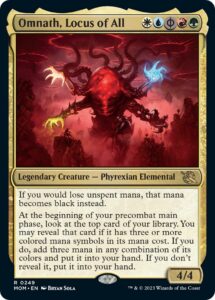
When it comes to powerful Phyrexian Commanders, look no further than Omnath, Locus of All. This exceptional choice grants access to all five colors of mana, making it a versatile option. Not only does it enable you to play all five Praetors, but it also provides mana acceleration when paired with multicolored cards. What sets Omnath apart is its unique ability to retain unspent mana as black mana, which remains available until Omnath leaves the battlefield.

One exciting interaction to consider is with cards like Villainous Wealth. With the right mana ramp, you can exile a significant number of cards and benefit greatly. Additionally, creatures like Nyxbloom Ancient help generate excess mana, which can be immediately utilized or saved for casting massive X spells like Torrent of Hellfire, capable of ending the game in one fell swoop.

To fully harness Omnath’s potential, take advantage of its second ability, which relies on multicolored cards. At the start of your precombat phase, you get to choose three mana from a combination of revealed colors. This opens the door to swiftly playing various powerful cards. For example, you can bring Maelstrom Nexus or Maelstrom Angel onto the battlefield, both of which require high multicolored costs.

A solid strategy with Omnath involves overwhelming your opponents with powerful creatures before they can respond. You can also leverage other Phyrexian cards like Vraska, Betrayal’s Sting, and Vorinclex, Monstrous Predator to inflict further damage and disruption on your foes.

Embrace the complexity and diversity that Omnath, Locus of All brings to the table. With its ability to tap into all five colors, fueling a burst of multicolored spells, the battlefield becomes your canvas for unparalleled magic and tactics.

Read Also: Everything You Need To Know About Ward in MTG

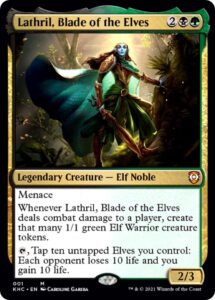
4. Lathril, Blade of the Elves

Elves have always been a beloved choice in Commander, and Lathril, Blade of the Elves takes their allure to new heights. Witness the captivating dance of combat as Lathril strikes her opponents, summoning 1/1 Elf tokens equal to her power. Once you have a grand total of ten Elves on the battlefield, you can tap them to drain ten life from each of your adversaries.

Your opponents will want to avoid Lathril dealing damage since accumulating 21 cumulative combat damage from her spells certain defeat. Not only does the damage add up, but Lathril also creates tokens equal to the damage dealt.

To excel with Lathril, focus on summoning a legion of Elves while draining your opponents’ life. Cards like Elvish Warmaster enable you to flood the battlefield with Elf tokens quickly, initiating a relentless life drain. Supporting cards such as Elvish Archdruid and Leaf-Crowned Visionary transform seemingly weak 1/1 Elves into formidable fighters. Rather than relying on simple removal spells like Lightning Bolt, force your opponents into wiping the entire board.

Further augment your Elves’ strength by combining cards like Ezuri, Renegade Leader, who can turn your Elf army into a force to be reckoned with. Backed by naturally powerful Elves like Glissa Sunslayer and Abomination of Llanowar, your opponents will have to find a way to neutralize or exile them. While these cards may have higher mana costs, you can expedite their arrival with cards like Llanowar Elves and Wirewood Channeler. As an added bonus, the combination of Elvish Archdruid and Staff of Domination can even grant you infinite mana.

To ensure your Elves’ survival and maintain focus on draining life from enemies, equip them with protective equipment and enchantments. Lightning Greaves and Swiftfoot Boots can safeguard your most powerful Elves from harm. Additionally, cards like Coat of Arms or Beastmaster’s Ascension can amplify your Elves’ power, overwhelming your opponents’ defenses.

With multiple avenues to thwart your opponents, watch them scramble to react as you adjust your strategy to the changing circumstances. Master the art of the Elves, and orchestrate a symphony of victory, where the power of nature reigns supreme.

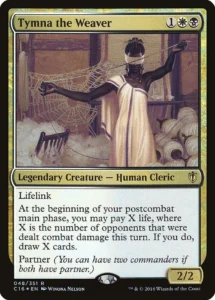
3. Tymna the Weaver

If you’re intrigued by the Partner mechanic that allows two Commanders, consider Tymna the Weaver. Tymna, often paired with Thrasios, Triton Hero, offers a range of benefits. With blue, green, white, and black mana, this partnership provides versatility and synergy.

Thrasios excels at ramping mana with his Scry ability. It allows you to reveal the top card of your library. If it’s a land, you play it tapped, and if it’s another card, you draw one. This helps control your hand while quickly bringing lands into play.

With enhanced mana ramp, you can deploy powerful cards like Elesh Norn, Grand Cenobite and Atraxa, Grand Unifier. The Scry ability isn’t limited to basic lands, so cards like Yavimaya, Cradle of Growth or Breeding Pool can be played. Creatures such as Birds of Paradise and Noble Hierarch can also contribute to your mana needs.

Tymna excels at card advantage. After dealing damage to players, you can pay life to draw cards equal to the number of players you damaged. This ability replenishes your hand in larger games, providing more options.

To offset Tymna’s life drain, include cards like Serra Ascendant or Sheoldred, the Apocalypse to gain life. Cards like Toxic Deluge can clear the board while benefiting from the extra life gained. Protecting your creatures, artifacts, and enchantments is crucial, so consider using cards like Counterspell or Heroic Intervention.

Tymna and Thrasios offer various paths to victory. Powerful creatures like Atraxa, Grand Unifier can end the battle. Exiling troublesome creatures with cards like Swords to Plowshares and strengthening your own creatures with counters can also lead to success.

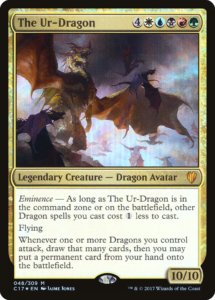
2. The Ur-Dragon

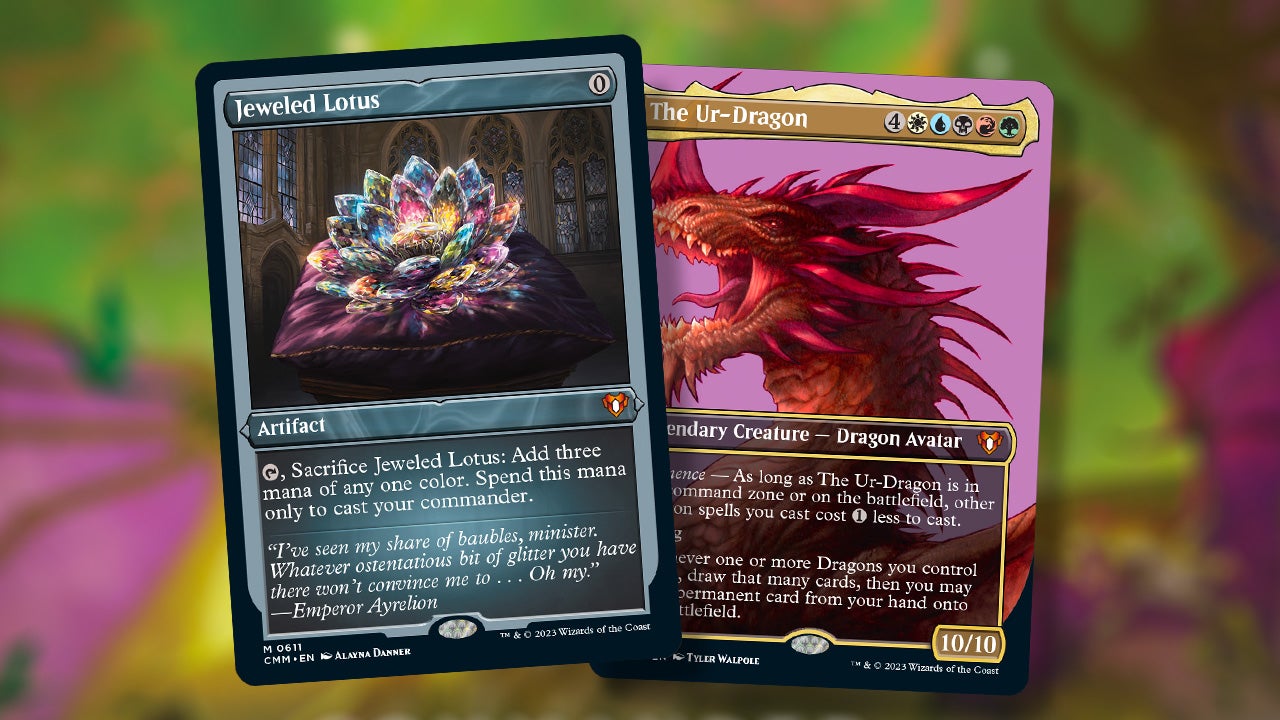
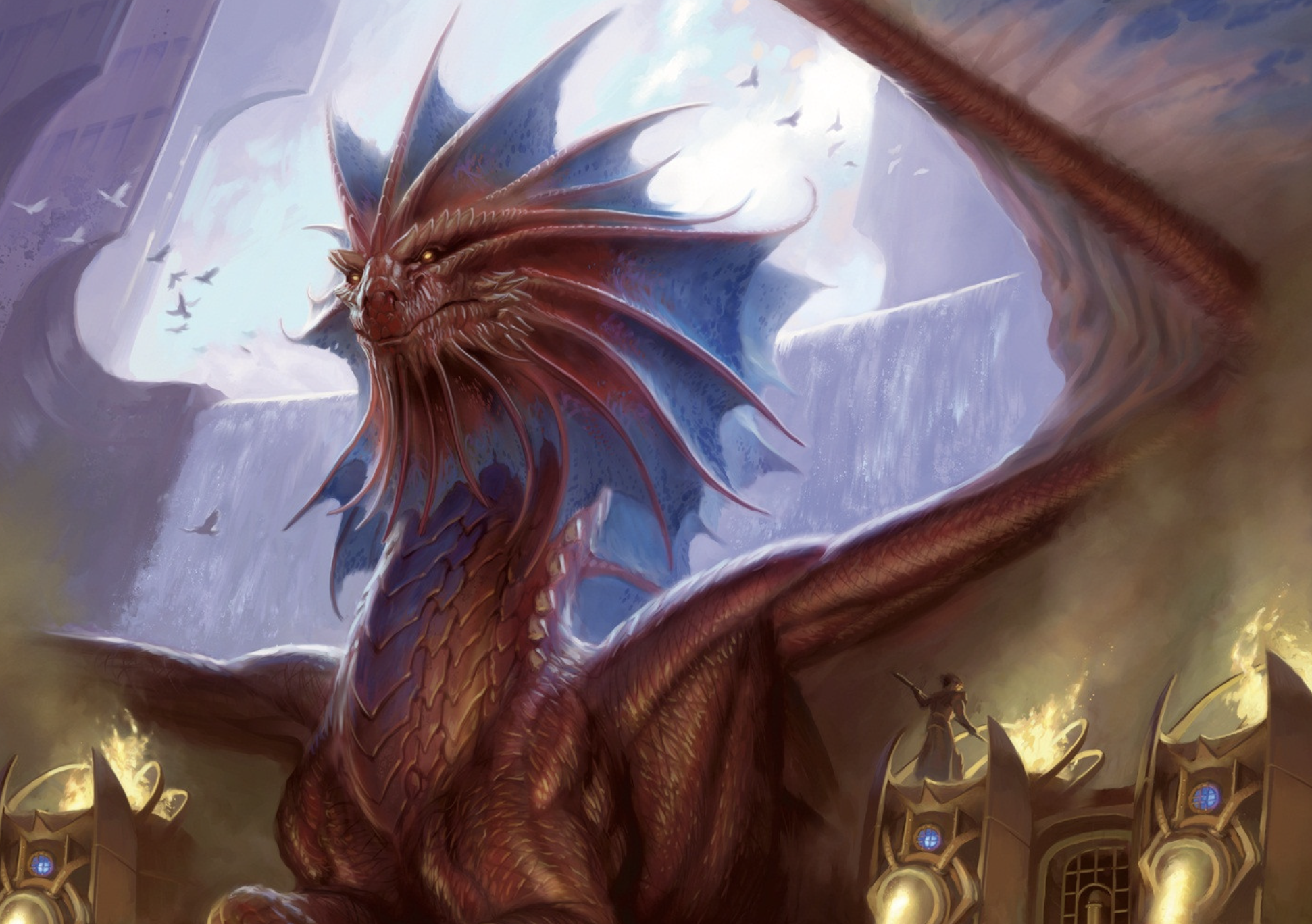
For Dragon enthusiasts, The Ur-Dragon is a formidable Commander choice. It grants access to every color and reduces the mana cost of Dragons by one. Though summoning The Ur-Dragon requires a substantial cost, the benefits are worthwhile. It allows any number of Dragons to attack, drawing cards and putting a permanent from your hand onto the battlefield.

Combining The Ur-Dragon with cards like Miirym, Sentinel Wyrm quickly populates the battlefield with powerful threats. Lathliss, Dragon Queen and Utvara Hellkite create Dragon tokens, increasing your attacking force.

Mana ramp is crucial for playing expensive Dragons. Scaled Nurturer and Faeburrow Elder generate mana early on. Cards like Cultivate and Growth Spiral help you acquire lands. Dragonspeaker Shaman reduces mana costs, expediting Dragon deployment.

Reviving Dragons is important as opponents may target them. Bladewing the Risen revives a Dragon while providing a body on the battlefield. Patriarch’s Bidding brings back all Dragons from the graveyard. In challenging situations, Crux of Fate buys you time or secures victory.

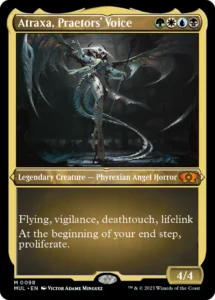
1. Atraxa, Praetor’s Voice

Atraxa, Praetor’s Voice is ideal for counter-focused Commander decks. It possesses Flying, Vigilance, Deathtouch, and Lifelink. The standout ability is Proliferate, triggering during the end step. It adds an additional counter to chosen permanents with counters.

Atraxa’s Proliferate ability doesn’t require any action, making it valuable. Prologue to Phyresis applies a Poison Counter to opponents without combat. Bloated Contaminator breaks through defenses to poison opponents.

Cards like Tekuthal, Inquiry Dominus and Inexorable Tide enable multiple Proliferations. Tekuthal can gain an Indestructible counter, enhancing resilience. Evolution Sage triggers Proliferation with each land played, while Ezuri, Stalker of Spheres aids in card advantage.

Atraxa also amplifies the power of planeswalkers like Teferi, Temporal Archmage. Combined with artifacts and mana-producing permanents, you can generate more mana and utilize loyalty abilities effectively. Vraska, Betrayal’s Sting and Vorinclex, Monstrous Raider capitalize on Proliferated poison counters.

To handle opposing threats, cards like Swords to Plowshares remove obstacles while preserving your survival. Astral Cornucopia and Shalai, Voice of Plenty provide other beneficial counters and advantage. Proliferation forces opponents to pay attention to you or risk defeat.

Everything You Need To Know About Ward in MTG

In the realm of Magic: The Gathering (MTG), Ward stands as an Evergreen mechanic, capable of integration into every MTG set. However, it’s worth noting that this isn’t always the case, although Ward remains notably widespread. Consequently, acquiring a solid understanding of this mechanic is crucial to avoid unexpected surprises.

Debuting in Strixhaven: School of Magic, Ward finds its place on numerous contemporary MTG cards, making it a highly favored ability, particularly for safeguarding creatures. Given its versatile design, players of MTG should anticipate encountering a multitude of cards showcasing this mechanism in upcoming releases.

If the concept of this mechanic is unfamiliar, you might be wondering about its functioning at this point. Fortunately, we’re here to offer guidance. Without further delay, let’s delve into a comprehensive exploration of everything you should grasp about Ward in MTG!

What exactly is Ward in MTG?

what is ward, ward mtg, mtg,

Ward represents a game mechanic that furnishes an extra layer of defense to a card, irrespective of its card type. This mechanic compels the opposing player to make an added expenditure in order to target a creature with effects. This generally translates to an additional payment necessary for the elimination of the creature using a targeted spell. Sometimes, this cost is an increase in mana, while it could also involve expending life or discarding a card.

The obligation of paying the Ward cost arises when aiming the ability at the permanent. Should you opt not to comply, your spell will be negated by the Ward capability.

In instances where your spell is negated or otherwise handled after the Ward cost has been paid, the extra cost is not reimbursed. Consequently, thoughtful consideration must be given to how and where you employ your removal tactics.

While this may appear to be straightforward, it’s imperative to recognize that the Ward cost isn’t factored in during spell casting. Instead, Ward functions as a triggered effect that activates solely when the creature becomes a target. As a result, in MTG Arena, it might appear plausible to target a creature with Ward even if you lack sufficient mana.

In addition to this digital idiosyncrasy, when using physical cards, it’s easy to overlook the presence of Ward. Therefore, it becomes crucial to stay attentive to permanents possessing this trait to prevent any unwelcome surprises. Thankfully, in the Arena, players have the flexibility to reconsider and retract actions if an additional cost is mandated for spell casting.

Read Also: Top 5 Best Cards in MTG Commander

What are Ward Requirements?

Thanks to Lord of the Rings: Tales of Middle-earth, the concept of Ward costs is taking on added intricacy. This shift is primarily attributed to the introduction of new elements like Saruman of Many Colors and Sauron, the Dark Lord.

For the first time, we encounter Ward costs that aren’t straightforward to meet under most game conditions. While players might generally manage to cover additional mana or part with some cards, having a Legendary Artifact or Creature at hand won’t necessarily be a common occurrence. Consequently, targeting Sauron with spells can pose a significant challenge.

To clarify, if you’re unable to fulfill the Ward cost of a particular card, the triggering spell for Ward will be nullified. This essentially implies that cards like Sauron might remain immune to targeting for a considerable duration.

It’s important to keep in mind that aside from using removal that doesn’t rely on targeting, another way to bypass Ward is to employ spells that cannot be countered. Ward is ineffective against these spells, as failing to pay the Ward cost results in the spell being countered. An uncounterable spell can circumvent this by simply proceeding without paying the cost.

Ultimately, Ward stands as a potent mechanic, particularly impactful in Limited game scenarios. Fortunately, being an evergreen mechanic suggests that it’s unlikely to be overly exploited within a single MTG set. Nevertheless, it’s still prudent to remain attentive to it in order to prevent your own spells from fizzling out.

Conclusion

In conclusion, delving into the mechanics of Ward in Magic: The Gathering opens up a realm of strategic depth and tactical possibilities. With its presence expanding through sets like Lord of the Rings: Tales of Middle-earth, Ward costs have evolved into more intricate and challenging facets, adding layers to gameplay dynamics.

The introduction of figures like Saruman of Many Colors and Sauron, the Dark Lord, has redefined the strategic landscape, demanding players to navigate nuanced choices when dealing with these formidable Ward costs.

While the concept of Ward may seem complex, its impact is undeniable, especially in Limited environments where it can sway the tide of battles. As an evergreen mechanic, Ward continues to enrich the MTG experience without saturating it, ensuring its relevance across diverse sets.

Beginners Guide To Power Levels in EDH

As an avid player of Elder Dragon Highlander (EDH) or Commander, I’m here to discuss with you guys about the different power levels you might encounter. EDH is known for its diverse range of power levels, allowing players to customize their decks to suit their preferred style of play. Here are some common categorizations of power levels you might come across:

  1. Casual: Casual EDH decks focus on fun interactions, flavorful themes, and casual play. They typically have a mix of basic and budget-friendly cards without many expensive or powerful staples. Casual games prioritize social interaction and may feature decks with unconventional strategies or tribal themes.
  2. Focused: Focused decks are more refined and streamlined than casual ones. They aim to win but often focus on a specific strategy or theme. These decks may include some more powerful and efficient cards, but they still prioritize interesting interactions and may avoid overly oppressive strategies.
  3. Competitive: Competitive EDH decks are designed with the goal of winning as efficiently and consistently as possible. They utilize powerful synergies, optimized mana bases, and often contain expensive staples. Competitive decks are typically built around a specific strategy and have efficient answers to common threats. These games tend to be faster-paced and more cutthroat.

Within these broad power level categories, there are further distinctions that you will have to consider:

Budget Decks

Budget decks are built with cost constraints in mind. They use affordable cards to create functional and enjoyable decks. While they may lack some of the powerful and expensive cards seen in higher-powered decks, budget decks can still be competitive and offer unique gameplay experiences.

Optimized Decks

Optimized decks are well-tuned versions of casual or focused decks. They may include more powerful and expensive cards to increase their consistency and effectiveness. These decks strike a balance between being strong and enjoyable to play against.

cEDH or High-Powered Decks

cEDH stands for “Competitive EDH” or “Commander with a competitive mindset.” These decks are designed to win as quickly and efficiently as possible using powerful card combinations, infinite combos, and highly optimized strategies. They often feature a significant number of expensive cards and are built to compete at the highest level of play.

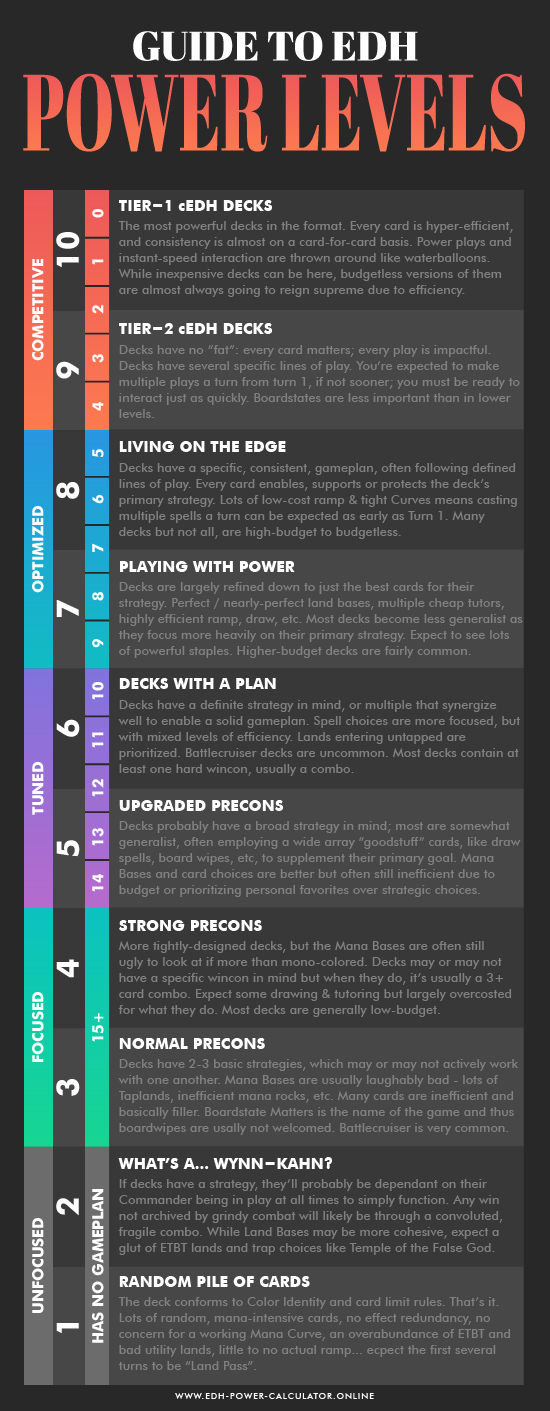
Additionally, there are tools available that can help you determine the power level of a Commander deck. One popular resource is our very own EDH Power Calculator tool, which assists players in assessing and rating the power level of their decks. Our calculator uses various factors, such as card selection, mana curve and speed to give you a better understanding about where your deck falls on the power spectrum.

Remember, power levels in EDH can be subjective and vary depending on the playgroup. It’s essential to communicate with your fellow players and establish a consensus on the desired power level before starting a game. This ensures everyone has an enjoyable experience and avoids potential mismatches.

I hope this article helped you understand the different power levels in EDH and enables you to make informed decisions when building or joining a Commander deck. I’ve also created an infographic that discusses the different EDH power levels in great detail. So, don’t forget to check that out as well.

Have fun playing!

edh power levels, power levels in edh, commander power levels