Duskmourn cEDH Set Review 2024

Greetings, creatures of the night! Ready to dig into the latest and creepiest cEDH gems from Magic: The Gathering’s newest set—Duskmourn: House of Horror. We’ve just left the adorable critters of Bloomburrow behind, and now we’re stepping into what might be the eeriest set ever (sorry, Innistrad, you had a good run). From the nastiest demonic tutor yet, to a slick alternative to Abrade, a massive Boros balloon that’s sure to make waves, a juicy new combo piece for Stella Lee, and a battlefield-wrecking Necrotic Ooze, this set is packed. Oh, and for all my Yuriko fans out there, get ready—Wizards just dropped a shiny new staple. So, grab your lanterns and let’s hunt down some game-changing cEDH cards!

UNWANTED REMAKE
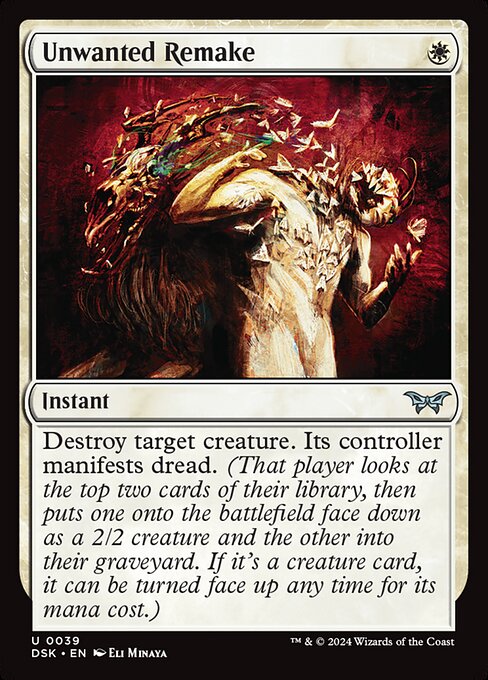
Unwanted Remake might just be the third-best white removal spell behind the classics Swords to Plowshares and Path to Exile. It’s cheap, instant-speed, and the drawback of giving your opponent a free creature is fairly minor, with the occasional bonus of messing up an opponent’s topdeck tutor.

It’s straightforward—good, old-fashioned manifesting, much like Reality Shift, a card that Unwanted Remake closely resembles.

That said, I predict Unwanted Remake will only see play in decks desperate for more removal after they’ve exhausted the usual go-tos. Unless, of course, a deck emerges that can abuse it in the same way Reality Shift used to be exploited: by looping it infinitely to mill out opponents, manifesting every card in their library.

COME BACK WRONG
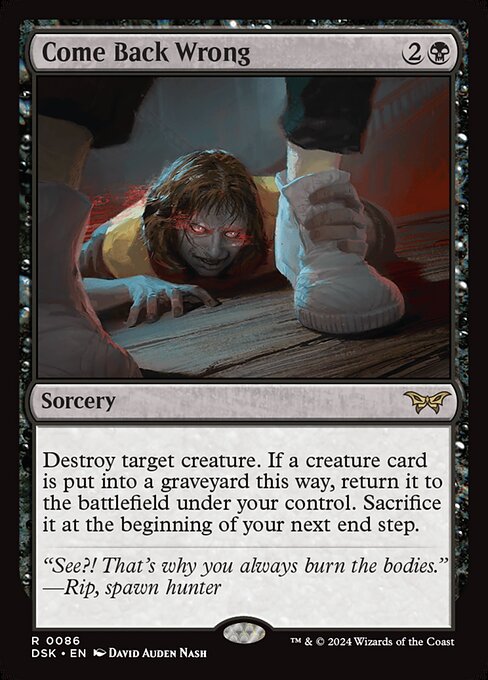
Come Back Wrong is a straightforward, versatile card—a mix of removal and clone. If you’re looking to take out a creature and get a shot at using its abilities, this might be worth considering. While you don’t keep the creature permanently, it’s great for stealing something like a Dockside Extortionist trigger, stopping your opponent from going infinite with bounce combos.

That being said, it’s a bit pricey at three mana and being limited to sorcery speed makes it feel clunky, so I doubt it’ll see much play in the mainstream cEDH scene.

BLUE

It’s a rare occasion to see a new set without any fresh cEDH tools for blue, usually the most stacked color. Yet, Duskmourn: House of Horrors has pulled it off. If I’ve missed something powerful in blue, I’d love to hear about it!

DEMONIC COUNSEL
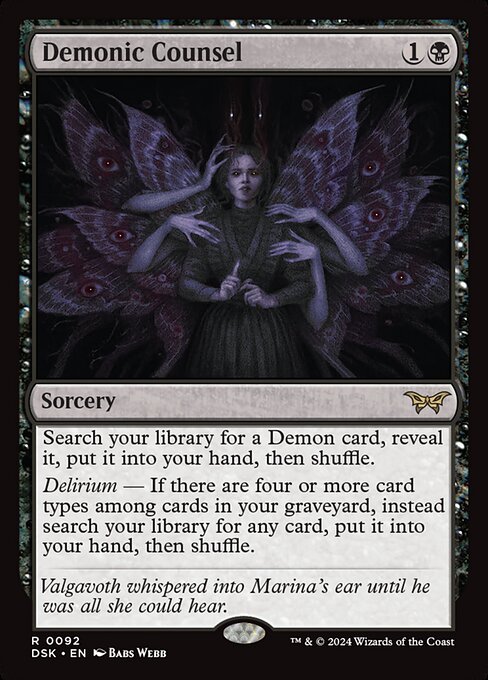
This is the ultimate Demonic Tutor—well, not because it’s strictly better, but because when it doesn’t function like Demonic Tutor, it still tutors for Demons. You ever say a word so many times it stops sounding real? That’s where I’m at with Demonic Counsel.

Now, in terms of Demons worth tutoring, there are really only two that stand out: Vilis, Broker of Blood and Razaketh, the Foulblooded. Unfortunately, neither sees as much play these days, but if you’re really in need of them on demand, Demonic Counsel isn’t a bad option.

For decks without Demons, though, you’re going to need a reliable way to trigger Delirium. Fetchlands help, as do self-mill and wheel effects, but don’t expect Demonic Counsel to be online early in the game—the turns that matter most in cEDH. Sure, other Delirium cards do see play, but look at Shifting Woodland—it’s still just a land without Delirium. And even Dragon’s Rage Channeler barely relies on its Delirium text. Because of this, I don’t see Demonic Counsel getting much play outside of specific niche builds, like Kaalia of the Vast. It could also find a place in Dargo, the Shipwrecker decks that want to tutor up Rakdos, the Muscle. But in most cases? It’ll likely stay on the sidelines.

DOOMSDAY EXCUCIATOR
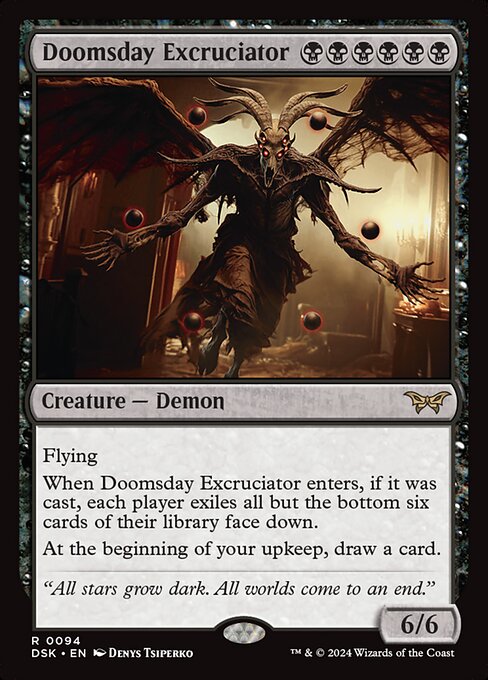
Six black pips on a single card? Perfectly fitting for a horror-themed set, and Doomsday Excruciator delivers with a unique, over-the-top effect and stunning artwork. Exiling all but the bottom six cards of all players’ libraries is a flashy and unprecedented move—but is it useful in cEDH? I’m not convinced.

If you’ve already got your win lined up and your opponents don’t, fantastic—you’ve effectively locked them out of the game, and you’re ready to take over. But here’s the thing: if you’re already in a position to win, wouldn’t you rather have something like Defense Grid, a counterspell, or any other form of protection instead? Your opponents may not be able to draw into their win conditions, but they can still interact with yours. Plus, Doomsday Excruciator leaves you with a ticking clock—you’ve got three turns before you deck yourself, thanks to the exile effect each turn.

All of this makes Doomsday Excruciator feel like a win-more card—something flashy but not impactful unless you’re already in a dominant position. While undeniably fun, it’s unlikely to find a home in most cEDH decks.

RAZORKIN NEEDLEHEAD
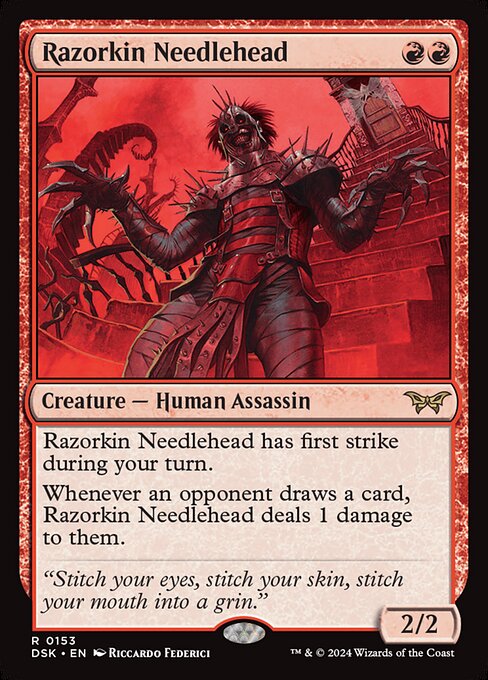
Razorkin Needlehead feels like what Orcish Bowmasters should’ve been—a strong deterrent to mass card draw that isn’t utterly busted or an auto-include in every deck. The problem? It’s so much weaker that I wish it had a bit more punch. It doesn’t need flash or an enter-the-battlefield trigger, but the ability to target creatures would’ve been a nice touch, especially for red decks that can handle two red pips.

As it is, Razorkin Needlehead probably won’t make the cut just to annoy the Rhystic Study player. It’s a bit too clunky for that. However, it does have a clear role in cEDH, particularly in Ob Nixilis, Captive Kingpin decks, where its synergy is more apparent. Otherwise, its lack of versatility will likely keep it on the sidelines.

UNTIMELY MALFUNCTION
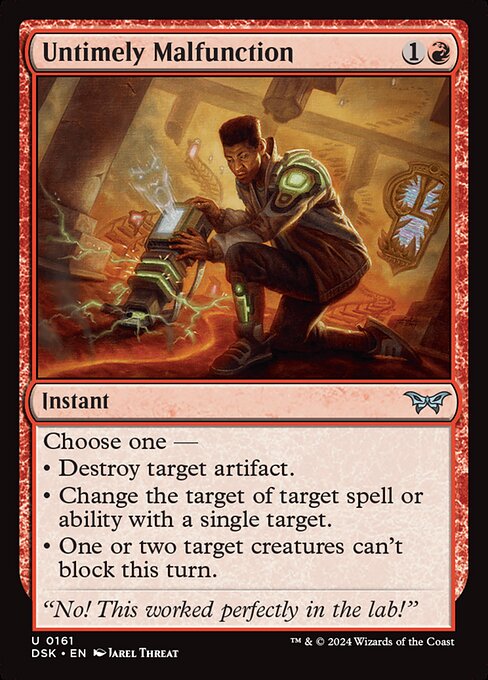
Untimely Malfunction serves as a sidegrade to the cEDH staple Abrade. If you’ve ever played a low-color red deck, you’re probably very familiar with Abrade—its flexibility to either remove a creature or destroy an artifact is always relevant. Most cEDH creatures have three toughness or less, and artifacts are abundant, so Abrade rarely misses. Untimely Malfunction, however, swaps out the artifact removal for the ability to either redirect a spell (in a Deflecting Swat style) or make two creatures unable to block.

While stopping blockers is situational—mainly useful for damage triggers or going for a lethal swing against a low-health player—the real value comes from its ability to redirect a spell. You can throw a Path to Exile or Swords to Plowshares back at its caster, protect a noncreature permanent from removal, or, perhaps most importantly, counter a counterspell by redirecting it to itself. This effect is already available in Deflecting Swat, which is free and therefore strictly better, but Untimely Malfunction is unique in offering this utility alongside creature removal.

Overall, I’d say Untimely Malfunction is slightly weaker than Abrade due to the loss of artifact removal, but if you’re in a low-color deck and need more flexible interaction that can remove a creature or protect one of your own, Untimely Malfunction could be a solid alternative.

VENGEFUL POSSESSION
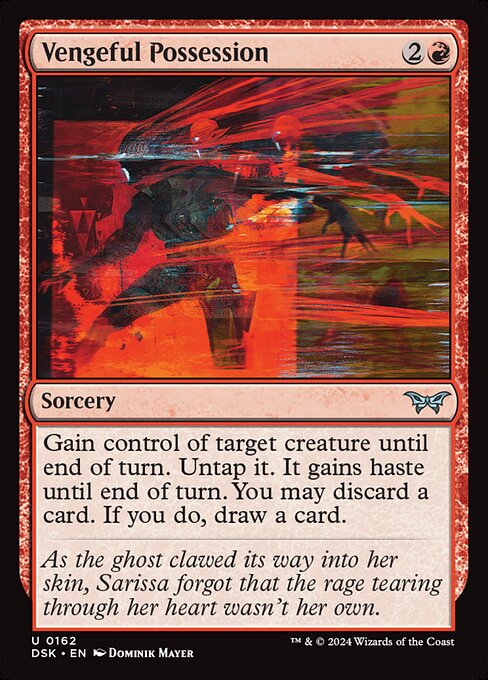
Threaten effects rarely make an impact in cEDH, usually reserved for draft decks—except for one key case: Stella Lee, Wild Card. For Stella, the value in taking control of a creature isn’t the point—you’re always targeting Stella herself. The real appeal of Vengeful Possession lies in the fact that it untaps the creature, enabling Stella’s primary combo of copying herself and untapping in an infinite loop. (For more on this combo, check out the link from our friends at Commander Spellbook.)

What makes Vengeful Possession particularly interesting is that it allows you to draw and discard with each iteration. While this is weaker than similar effects like Crimson Wisps or Cerulean Wisps—since it’s card-neutral rather than card-positive—it still enables you to dig through your deck, helping you find Twisted Fealty, which is the actual win condition. The discard also feeds into Underworld Breach lines, adding an extra layer of synergy.

If you’re curious about playing Stella Lee, Wild Card in cEDH, Josh LeBlanc from ElderDrunkenHighlander has put together a comprehensive writeup on the deck, which is worth checking out for deeper insights.

CONCLUSION

Duskmourn: House of Horrors ranks among the weaker sets I’ve reviewed for cEDH. While I’m excited about Kaito, Bane of Nightmares and expect The Master of Keys to be a hit with reanimation enthusiasts, and Marvin, Murderous Mimic certainly has endless combo potential, there’s just not a lot to sink your teeth into. From a cEDH standpoint, this set feels less like The Exorcist or The Thing and more like Winnie-the-Pooh: Blood and Honey—not great.

But as I always emphasize, that’s perfectly okay! Magic sets aren’t crafted specifically with cEDH in mind, and despite the growing popularity of our quirky little subformat, I believe they shouldn’t have to cater to it. Until next time…
What Does Flash Do in MTG

If you’ve ever found yourself delving into the enchanting realms of Magic: The Gathering (MTG), you might have come across an intriguing mechanic known as Flash. And no, it’s not about a camera and some blinding lights – though it does capture our attention like a well-timed photograph. In this magical journey, let me be your guide to unravel the mystery behind Flash, a spellbinding ability that might just give you the edge in your next epic duel!

The Birth of a Spark

Imagine yourself strolling through the lush forests of Zendikar, or perhaps traversing the murky swamps of Innistrad, as you prepare for the ultimate confrontation. Your deck, carefully crafted with an assortment of powerful creatures, instants, and sorceries, awaits its moment to shine. But hold on – your adversary is always ready to strike, and with conventional spells, you might find yourself outmaneuvered.

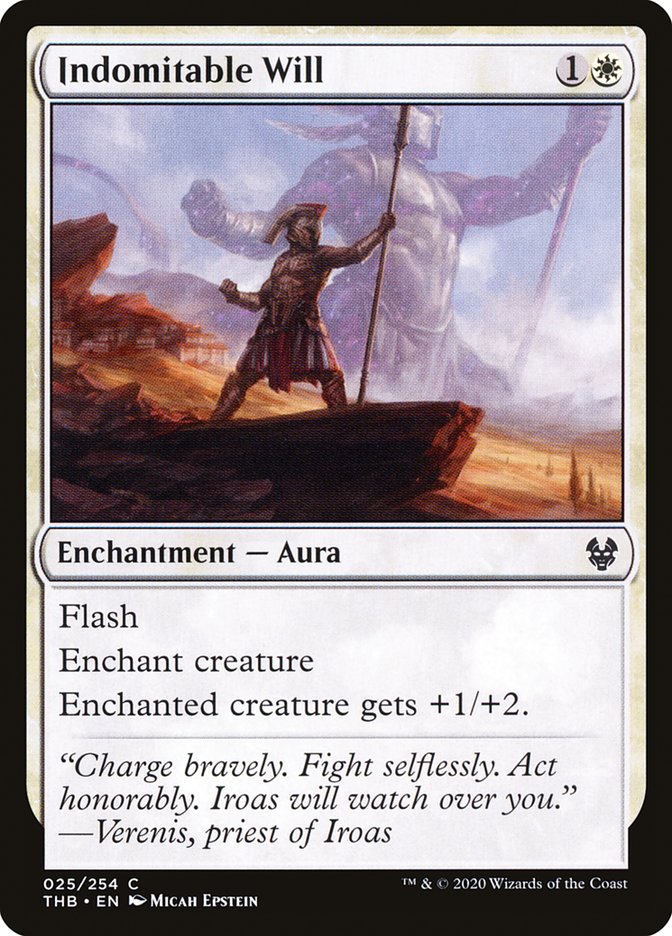
That’s where Flash enters the stage – a game-changer that adds a dash of spontaneity to your gameplay. Flash is a keyword ability that lets you play certain cards at unexpected moments – during your opponent’s turn, to be precise. This means you can cast creatures and other cards at lightning speed, right when your rival least expects it. It’s like surprising your friend with a party out of nowhere – they’ll never see it coming!

See Also: What is Vigilance in MTG

The Art of Surprise

Now, you might wonder what makes Flash so special? Well, my fellow planeswalkers, it all boils down to the element of surprise. Picture this: you’re staring into your opponent’s steely gaze, trying to predict their next move. Suddenly, from the depths of your mana pool, you unleash a creature with Flash. Your opponent’s jaw drops, their cunning strategy now in disarray.

But let’s not get ahead of ourselves – how does it work? Simply put, a creature with Flash can be summoned during your opponent’s turn, as though it had sprouted from the blind spots of the Multiverse. Usually, creatures are brought into play during your own turn, leaving them vulnerable until your next turn rolls around. However, creatures with Flash sidestep this convention, arriving on the battlefield at opportune moments, and vanishing just as quickly.

Creatures of the Shadows

Some creatures are born for the shadows – lurking, waiting, and ready to pounce when the time is right. Meet the Nightstalker, a mysterious entity draped in darkness and shrouded in mist. With a flick of its shadowy tendrils, it enters the fray when you need it most – while your opponent fumbles to maintain their composure.

Or perhaps you prefer the power of faeries, those mischievous beings flitting through the woods of Lorwyn. A creature like the Quickling embodies the essence of Flash, darting in and out of reality like a mesmerizing dance. One moment, it’s absent from the field; the next, it’s there, casting its enchanting allure over the battlefield.

Creatures with Flash are like allies who’ve mastered the art of invisibility – they appear when the situation demands it and vanish when it’s time to regroup. Like ninjas of the card game world, they strike from the shadows and melt away before your opponent’s eyes.

Instant Gratification

Flash doesn’t limit its allure to creatures alone. Oh no, dear planeswalkers, it extends its charm to an array of spells as well. Instants and cards with Flash enchant your gameplay with a symphony of surprise, turning your opponent’s plans into a whimsical melody.

Imagine your opponent’s grin as they smugly pass the turn to you, confident in their defenses. But you hold the key to unravel their schemes. With an Instant spell equipped with Flash, you counter their strategy, leaving them with mouths agape. Your Instant casts itself like a spellbound wisp, ready to foil even the most elaborate of schemes.

Not to mention the joy of ambushing your foe with a creature during their turn – but that’s not all. The Flash mechanic allows you to play enchantments and artifacts too, evoking a sense of spontaneity that few other mechanics can rival. A magical artifact with Flash might suddenly reveal itself on the battlefield, baffling your rival and shifting the tide of the game.

Flash on the Battlefields

It’s not just the raw power that makes Flash so captivating; it’s the strategic potential it brings to the table. Flash empowers you to adapt, improvise, and outwit your opponent, making each duel an unpredictable masterpiece. Whether you’re defending your plane from dark forces or embarking on a whimsical adventure through the realms, the Flash mechanic is your secret weapon.

Next time you hold a card with Flash in your hands, think of it as a spark of potential – a spark that can ignite the flames of surprise and inspiration. Embrace the Flash, and let it guide you through the myriad possibilities of Magic: The Gathering. Happy dueling, my fellow planeswalkers – may your spark shine bright, and your triumphs be as unexpected as a Flash in the dark!

Conclusion

In the enchanting world of Magic: The Gathering, the mechanics that shape our duels are as diverse as the planes we traverse. Among them, Flash stands as a captivating ability that adds an electrifying element of surprise to our gameplay. Like a hidden ace up our sleeves, creatures and spells with Flash grant us the power to cast them when our adversaries least expect it.

The allure of Flash lies not just in its spontaneity, but also in its strategic brilliance. Creatures born with this ability emerge from the shadows, ready to strike and vanish just as swiftly. They are the ninjas of the battlefield, masters of surprise and masters of our fate. Instants and spells with Flash offer us the means to counter our opponents’ moves, turning the tides of the game with a spellbound wisp of magic.

Beyond the mechanics, Flash speaks to the essence of the planeswalker within us all – the spark of creativity and adaptability that guides our journey. It encourages us to think beyond conventional playstyles, to embrace the unexpected, and to savor the joy of outwitting our rivals.

With Flash in our decks, we can rewrite the narratives of our battles, leaving our opponents in awe and ourselves with stories to recount for ages to come. Let us savor the thrill of the unexpected, for it is in those fleeting moments that true magic resides.

So, my fellow planeswalkers, may your decks be graced with the spark of Flash, and may your journeys be filled with countless unforgettable moments. As you embrace the element of surprise, remember that the true magic of MTG lies not just in the cards we hold but in the adventures we share and the friendships we forge along the way.

Why is MTG So Addictive?

More often than not, you’ve probably come across or are acquainted with at least one individual engaged in the activity of playing Magic: the Gathering. You might even be a participant yourself.

One aspect that numerous individuals have observed upon immersing themselves in the game is its capacity to ensnare them once they’ve initiated their involvement. So, what makes MTG so addictive?

There exist numerous valid explanations for the steadfast enthusiast community that surrounds this iconic card game. We will elucidate these factors for you.

To put it succinctly, Magic: the Gathering is a card game that originated in 1993. Multiple players, usually two or more, engage in a competition to deplete each other’s life points to zero as the condition for victory. While this stands as the primary method of achieving triumph, various alternative paths also exist.

Spanning nearly three decades, the game has introduced tens of thousands of cards. The potential amalgamations of cards within a deck are virtually limitless.

See Also: Top 5 Best Cards in MTG

Why is MTG so addictive – Top 6 Reasons

Had Magic: the Gathering not possessed appealing elements for its players, its popularity would have waned years ago.

Thankfully, the creators, Wizards of the Coast, exhibit ingenuity. They consistently introduce fresh attributes to incorporate into the game, which captivate enthusiasts and maintain their engagement.

The primary factors that sustain players’ involvement in MTG include:

  • Cards of substantial value
  • Boundless potential for deck configurations
  • Diverse conclusions in each match
  • Engaging in MTG with friends
  • Constantly expanding card pool
  • Competitive environment

Cards of Substantial Value

Similar to various other collectible items, Magic: the Gathering (MTG) cards have the potential to appreciate significantly in value over time.

The rare and elusive Black Lotus card, originally featured in the inaugural Magic set, notably fetched a staggering $166,100 in 2019. You can delve into further details about this sale here.

Clearly, this instance is more of an anomaly rather than the standard. Black Lotus is widely recognized among Magic players, both newcomers and veterans, for its exceptionally steep cost.

Nonetheless, numerous other cards also observe their prices gradually ascend with the passage of time. Consequently, many players opt to amass cards that exhibit the potential to become valuable in the future.

This phenomenon amplifies the excitement of opening a booster pack. The prospect of obtaining something rare and valuable adds an extra layer of thrill.

Boundless Potential For Deck Configurations

Constructing a potent Magic deck is akin to a work of art.

Due to the extensive array of cards available, it’s highly improbable for any two decks to be identical. The vast range of options allows for the customization of a deck to align with individual preferences.

Numerous players find themselves engrossed in the process of building one deck after another. The introduction of new cards often triggers fresh waves of inspiration.

A few individuals even end up curating a collection of diverse decks for varying occasions or moods.

Given the ability to continually craft entirely distinct decks, it’s unsurprising that some Magic players persistently return to, or remain entrenched in, the game.

Recommended: Guide to Power Levels in EDH

Diverse Conclusions in Each Match

Much like the endless potential for diverse decks, the games themselves in Magic: the Gathering (MTG) are also boundless in variety.

With numerous players maintaining multiple decks that employ various mechanics, the ambiance and outcome of each game can undergo significant shifts. Players have the flexibility to switch decks between games or even transition to entirely different game formats.

Unlike a traditional board game with fixed victory conditions, MTG’s conditions change with each match, infusing a sense of novelty into nearly every encounter.

The game’s capacity to provide a fresh experience every time it’s played makes it difficult to become bored with.

Engaging in MTG with Friends

One of the remarkable aspects contributing to Magic’s popularity is its inherent social nature.

It’s not designed for solitary play. As a result, it has become a staple for game nights among groups of friends around the globe.

Friends can observe each other’s deck creations, identify the decks that summon the most formidable creatures, and analyze the synergies between spells. Just like many other games, the addition of close friends elevates the enjoyment, and MTG is no exception.

Constantly Expanding Card Pool

Right when you believe you’ve encountered everything, a fresh set of cards is introduced, brimming with captivating new mechanics.

Before players have the opportunity to settle into a sense of complacency, the card pool experiences expansion. This necessitates fans to continuously evolve and adapt to the evolving landscape in order to consistently excel in games.

Moreover, MTG’s perpetual evolution bestows a sense of novelty year after year. The consistent influx of new cards ensures that everyone’s preferences and interests are catered to.

Competitive

Games often evoke the competitive spirit within individuals, and Magic: the Gathering (MTG) is particularly adept at amplifying this aspect among its players.

Owing to the innate competitive nature of its fan base, MTG tournaments are held in abundance and with great frequency. Prizes in these competitions range from valuable cards to monetary rewards.

Yet, even for those who don’t participate at a level deemed professional, a substantial number of individuals find themselves engaged in friendly competition with their peers through MTG. Constructing a deck that garners admiration from friends brings about a profound sense of satisfaction.

This impetus to excel, which MTG ignites within individuals, is another compelling factor that sustains the commitment of its fan base.

Conclusion

n conclusion, the irresistible allure of Magic: the Gathering’s addictive nature stems from its multifaceted appeal. From the tantalizing potential for valuable card investments to the ever-evolving deck configurations, the game’s ability to offer fresh experiences with each match keeps players engaged.

The social camaraderie fostered by competing with friends and the unrelenting competitive spirit that MTG ignites further contribute to its captivating grasp. The continuous expansion of the card pool and the drive for excellence that it inspires ensure that the game never loses its novelty.

Through these myriad elements, Magic: the Gathering seamlessly weaves a tapestry of addiction, drawing players back time and again for another spellbinding encounter.