Greetings, creatures of the night! Ready to dig into the latest and creepiest cEDH gems from Magic: The Gathering’s newest set—Duskmourn: House of Horror. We’ve just left the adorable critters of Bloomburrow behind, and now we’re stepping into what might be the eeriest set ever (sorry, Innistrad, you had a good run). From the nastiest demonic tutor yet, to a slick alternative to Abrade, a massive Boros balloon that’s sure to make waves, a juicy new combo piece for Stella Lee, and a battlefield-wrecking Necrotic Ooze, this set is packed. Oh, and for all my Yuriko fans out there, get ready—Wizards just dropped a shiny new staple. So, grab your lanterns and let’s hunt down some game-changing cEDH cards!
UNWANTED REMAKE
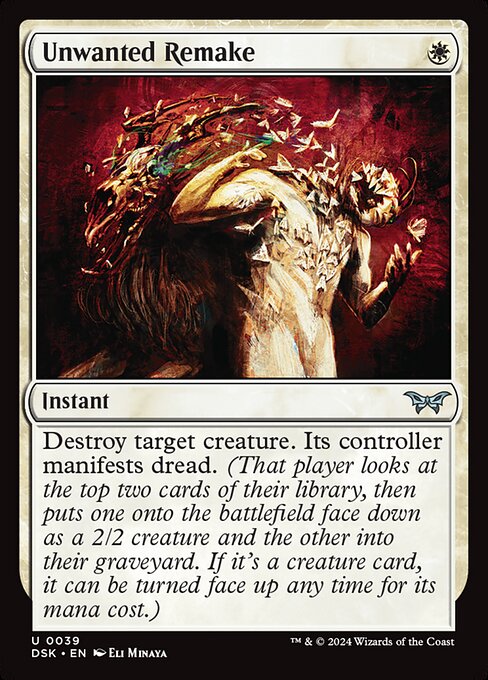
Unwanted Remake might just be the third-best white removal spell behind the classics Swords to Plowshares and Path to Exile. It’s cheap, instant-speed, and the drawback of giving your opponent a free creature is fairly minor, with the occasional bonus of messing up an opponent’s topdeck tutor.
It’s straightforward—good, old-fashioned manifesting, much like Reality Shift, a card that Unwanted Remake closely resembles.
That said, I predict Unwanted Remake will only see play in decks desperate for more removal after they’ve exhausted the usual go-tos. Unless, of course, a deck emerges that can abuse it in the same way Reality Shift used to be exploited: by looping it infinitely to mill out opponents, manifesting every card in their library.
COME BACK WRONG
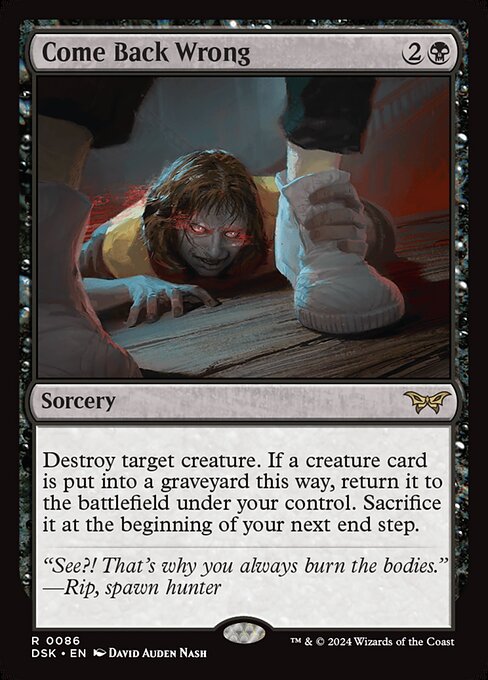
Come Back Wrong is a straightforward, versatile card—a mix of removal and clone. If you’re looking to take out a creature and get a shot at using its abilities, this might be worth considering. While you don’t keep the creature permanently, it’s great for stealing something like a Dockside Extortionist trigger, stopping your opponent from going infinite with bounce combos.
That being said, it’s a bit pricey at three mana and being limited to sorcery speed makes it feel clunky, so I doubt it’ll see much play in the mainstream cEDH scene.
BLUE
It’s a rare occasion to see a new set without any fresh cEDH tools for blue, usually the most stacked color. Yet, Duskmourn: House of Horrors has pulled it off. If I’ve missed something powerful in blue, I’d love to hear about it!
DEMONIC COUNSEL
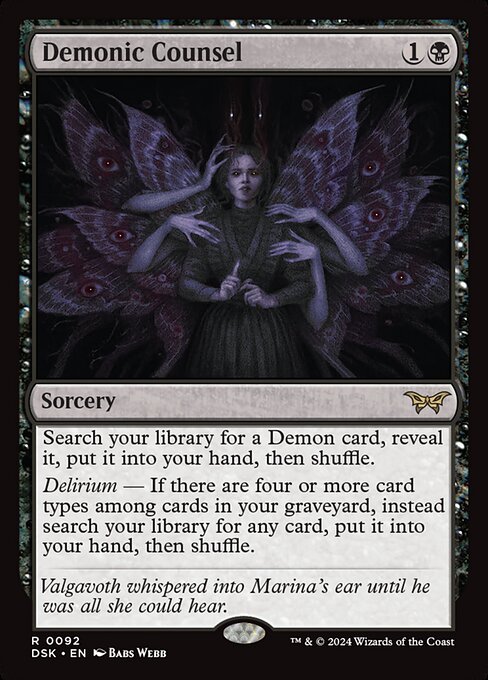
This is the ultimate Demonic Tutor—well, not because it’s strictly better, but because when it doesn’t function like Demonic Tutor, it still tutors for Demons. You ever say a word so many times it stops sounding real? That’s where I’m at with Demonic Counsel.
Now, in terms of Demons worth tutoring, there are really only two that stand out: Vilis, Broker of Blood and Razaketh, the Foulblooded. Unfortunately, neither sees as much play these days, but if you’re really in need of them on demand, Demonic Counsel isn’t a bad option.
For decks without Demons, though, you’re going to need a reliable way to trigger Delirium. Fetchlands help, as do self-mill and wheel effects, but don’t expect Demonic Counsel to be online early in the game—the turns that matter most in cEDH. Sure, other Delirium cards do see play, but look at Shifting Woodland—it’s still just a land without Delirium. And even Dragon’s Rage Channeler barely relies on its Delirium text. Because of this, I don’t see Demonic Counsel getting much play outside of specific niche builds, like Kaalia of the Vast. It could also find a place in Dargo, the Shipwrecker decks that want to tutor up Rakdos, the Muscle. But in most cases? It’ll likely stay on the sidelines.
DOOMSDAY EXCUCIATOR
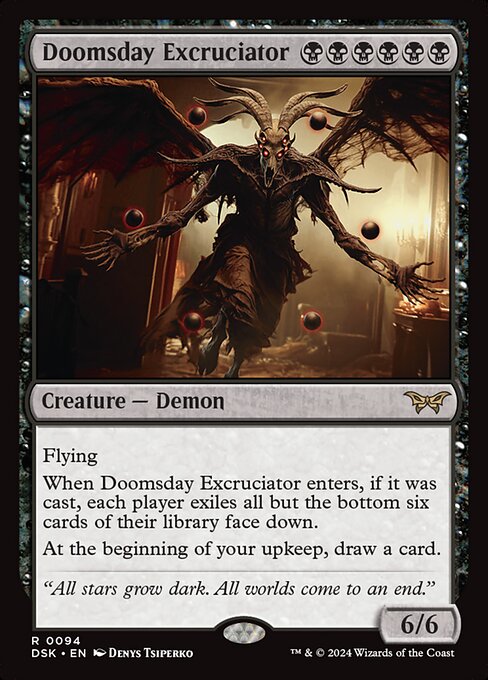
Six black pips on a single card? Perfectly fitting for a horror-themed set, and Doomsday Excruciator delivers with a unique, over-the-top effect and stunning artwork. Exiling all but the bottom six cards of all players’ libraries is a flashy and unprecedented move—but is it useful in cEDH? I’m not convinced.
If you’ve already got your win lined up and your opponents don’t, fantastic—you’ve effectively locked them out of the game, and you’re ready to take over. But here’s the thing: if you’re already in a position to win, wouldn’t you rather have something like Defense Grid, a counterspell, or any other form of protection instead? Your opponents may not be able to draw into their win conditions, but they can still interact with yours. Plus, Doomsday Excruciator leaves you with a ticking clock—you’ve got three turns before you deck yourself, thanks to the exile effect each turn.
All of this makes Doomsday Excruciator feel like a win-more card—something flashy but not impactful unless you’re already in a dominant position. While undeniably fun, it’s unlikely to find a home in most cEDH decks.
RAZORKIN NEEDLEHEAD
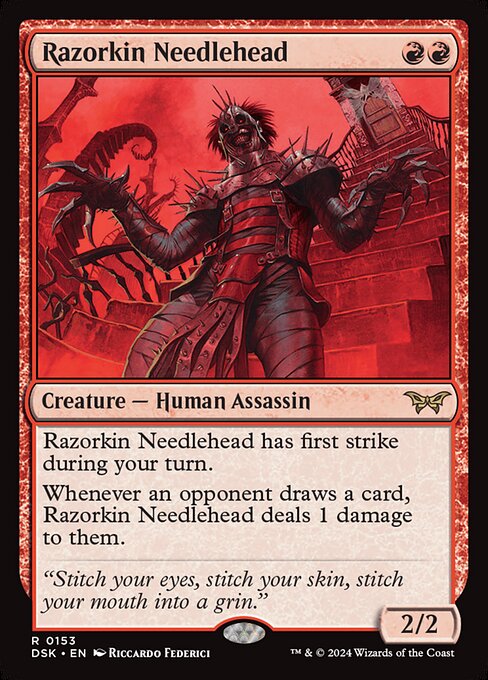
Razorkin Needlehead feels like what Orcish Bowmasters should’ve been—a strong deterrent to mass card draw that isn’t utterly busted or an auto-include in every deck. The problem? It’s so much weaker that I wish it had a bit more punch. It doesn’t need flash or an enter-the-battlefield trigger, but the ability to target creatures would’ve been a nice touch, especially for red decks that can handle two red pips.
As it is, Razorkin Needlehead probably won’t make the cut just to annoy the Rhystic Study player. It’s a bit too clunky for that. However, it does have a clear role in cEDH, particularly in Ob Nixilis, Captive Kingpin decks, where its synergy is more apparent. Otherwise, its lack of versatility will likely keep it on the sidelines.
UNTIMELY MALFUNCTION
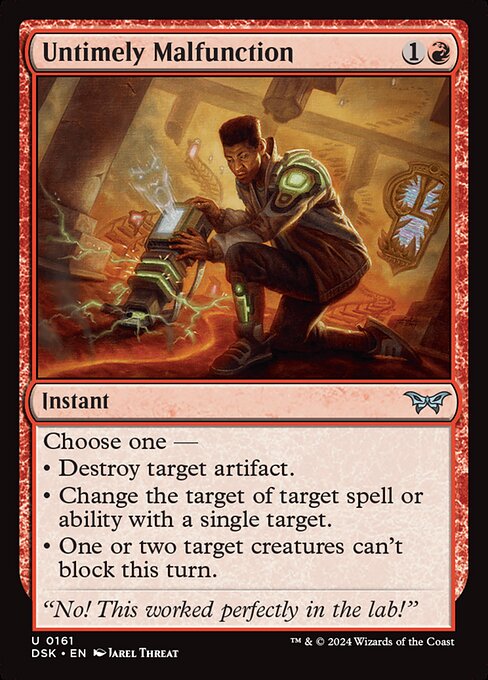
Untimely Malfunction serves as a sidegrade to the cEDH staple Abrade. If you’ve ever played a low-color red deck, you’re probably very familiar with Abrade—its flexibility to either remove a creature or destroy an artifact is always relevant. Most cEDH creatures have three toughness or less, and artifacts are abundant, so Abrade rarely misses. Untimely Malfunction, however, swaps out the artifact removal for the ability to either redirect a spell (in a Deflecting Swat style) or make two creatures unable to block.
While stopping blockers is situational—mainly useful for damage triggers or going for a lethal swing against a low-health player—the real value comes from its ability to redirect a spell. You can throw a Path to Exile or Swords to Plowshares back at its caster, protect a noncreature permanent from removal, or, perhaps most importantly, counter a counterspell by redirecting it to itself. This effect is already available in Deflecting Swat, which is free and therefore strictly better, but Untimely Malfunction is unique in offering this utility alongside creature removal.
Overall, I’d say Untimely Malfunction is slightly weaker than Abrade due to the loss of artifact removal, but if you’re in a low-color deck and need more flexible interaction that can remove a creature or protect one of your own, Untimely Malfunction could be a solid alternative.
VENGEFUL POSSESSION
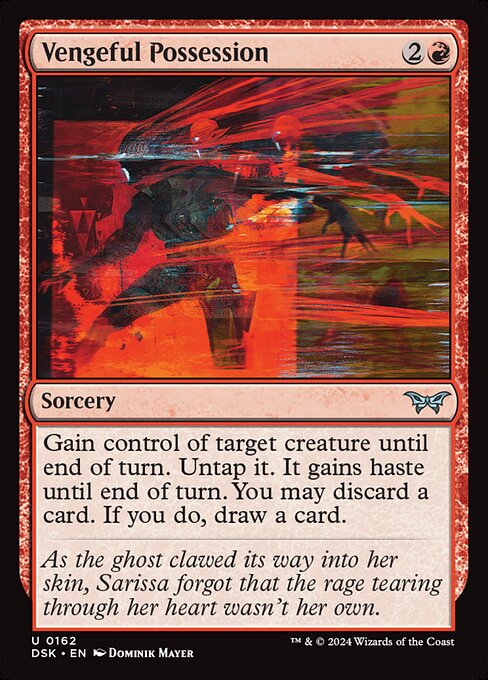
Threaten effects rarely make an impact in cEDH, usually reserved for draft decks—except for one key case: Stella Lee, Wild Card. For Stella, the value in taking control of a creature isn’t the point—you’re always targeting Stella herself. The real appeal of Vengeful Possession lies in the fact that it untaps the creature, enabling Stella’s primary combo of copying herself and untapping in an infinite loop. (For more on this combo, check out the link from our friends at Commander Spellbook.)
What makes Vengeful Possession particularly interesting is that it allows you to draw and discard with each iteration. While this is weaker than similar effects like Crimson Wisps or Cerulean Wisps—since it’s card-neutral rather than card-positive—it still enables you to dig through your deck, helping you find Twisted Fealty, which is the actual win condition. The discard also feeds into Underworld Breach lines, adding an extra layer of synergy.
If you’re curious about playing Stella Lee, Wild Card in cEDH, Josh LeBlanc from ElderDrunkenHighlander has put together a comprehensive writeup on the deck, which is worth checking out for deeper insights.
CONCLUSION
Duskmourn: House of Horrors ranks among the weaker sets I’ve reviewed for cEDH. While I’m excited about Kaito, Bane of Nightmares and expect The Master of Keys to be a hit with reanimation enthusiasts, and Marvin, Murderous Mimic certainly has endless combo potential, there’s just not a lot to sink your teeth into. From a cEDH standpoint, this set feels less like The Exorcist or The Thing and more like Winnie-the-Pooh: Blood and Honey—not great.
But as I always emphasize, that’s perfectly okay! Magic sets aren’t crafted specifically with cEDH in mind, and despite the growing popularity of our quirky little subformat, I believe they shouldn’t have to cater to it. Until next time…