Duskmourn cEDH Set Review 2024

Greetings, creatures of the night! Ready to dig into the latest and creepiest cEDH gems from Magic: The Gathering’s newest set—Duskmourn: House of Horror. We’ve just left the adorable critters of Bloomburrow behind, and now we’re stepping into what might be the eeriest set ever (sorry, Innistrad, you had a good run). From the nastiest demonic tutor yet, to a slick alternative to Abrade, a massive Boros balloon that’s sure to make waves, a juicy new combo piece for Stella Lee, and a battlefield-wrecking Necrotic Ooze, this set is packed. Oh, and for all my Yuriko fans out there, get ready—Wizards just dropped a shiny new staple. So, grab your lanterns and let’s hunt down some game-changing cEDH cards!

UNWANTED REMAKE
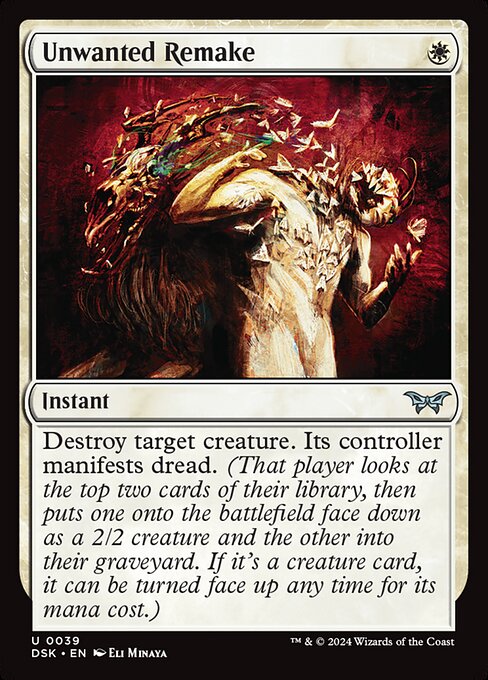
Unwanted Remake might just be the third-best white removal spell behind the classics Swords to Plowshares and Path to Exile. It’s cheap, instant-speed, and the drawback of giving your opponent a free creature is fairly minor, with the occasional bonus of messing up an opponent’s topdeck tutor.

It’s straightforward—good, old-fashioned manifesting, much like Reality Shift, a card that Unwanted Remake closely resembles.

That said, I predict Unwanted Remake will only see play in decks desperate for more removal after they’ve exhausted the usual go-tos. Unless, of course, a deck emerges that can abuse it in the same way Reality Shift used to be exploited: by looping it infinitely to mill out opponents, manifesting every card in their library.

COME BACK WRONG
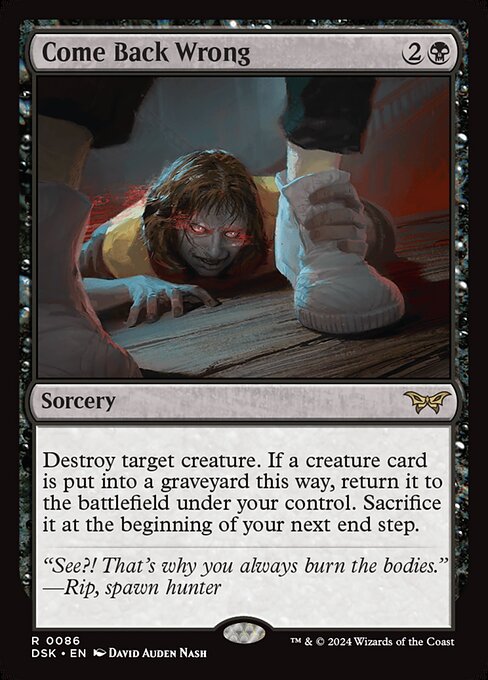
Come Back Wrong is a straightforward, versatile card—a mix of removal and clone. If you’re looking to take out a creature and get a shot at using its abilities, this might be worth considering. While you don’t keep the creature permanently, it’s great for stealing something like a Dockside Extortionist trigger, stopping your opponent from going infinite with bounce combos.

That being said, it’s a bit pricey at three mana and being limited to sorcery speed makes it feel clunky, so I doubt it’ll see much play in the mainstream cEDH scene.

BLUE

It’s a rare occasion to see a new set without any fresh cEDH tools for blue, usually the most stacked color. Yet, Duskmourn: House of Horrors has pulled it off. If I’ve missed something powerful in blue, I’d love to hear about it!

DEMONIC COUNSEL
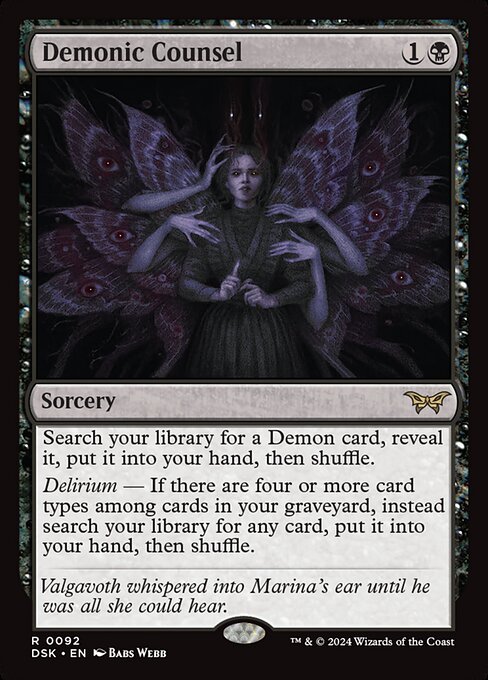
This is the ultimate Demonic Tutor—well, not because it’s strictly better, but because when it doesn’t function like Demonic Tutor, it still tutors for Demons. You ever say a word so many times it stops sounding real? That’s where I’m at with Demonic Counsel.

Now, in terms of Demons worth tutoring, there are really only two that stand out: Vilis, Broker of Blood and Razaketh, the Foulblooded. Unfortunately, neither sees as much play these days, but if you’re really in need of them on demand, Demonic Counsel isn’t a bad option.

For decks without Demons, though, you’re going to need a reliable way to trigger Delirium. Fetchlands help, as do self-mill and wheel effects, but don’t expect Demonic Counsel to be online early in the game—the turns that matter most in cEDH. Sure, other Delirium cards do see play, but look at Shifting Woodland—it’s still just a land without Delirium. And even Dragon’s Rage Channeler barely relies on its Delirium text. Because of this, I don’t see Demonic Counsel getting much play outside of specific niche builds, like Kaalia of the Vast. It could also find a place in Dargo, the Shipwrecker decks that want to tutor up Rakdos, the Muscle. But in most cases? It’ll likely stay on the sidelines.

DOOMSDAY EXCUCIATOR
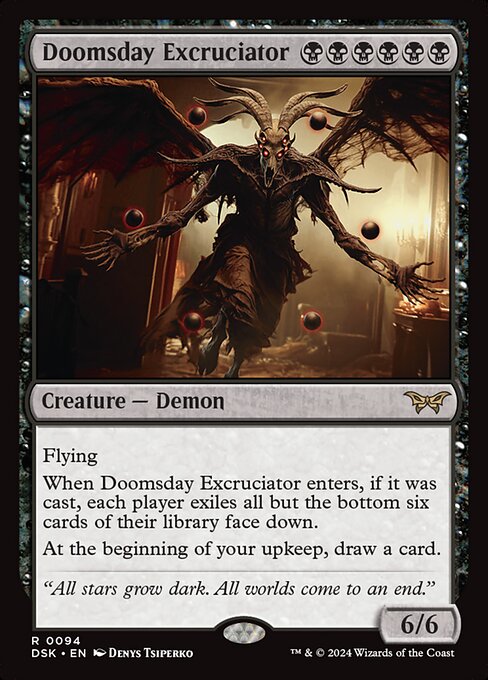
Six black pips on a single card? Perfectly fitting for a horror-themed set, and Doomsday Excruciator delivers with a unique, over-the-top effect and stunning artwork. Exiling all but the bottom six cards of all players’ libraries is a flashy and unprecedented move—but is it useful in cEDH? I’m not convinced.

If you’ve already got your win lined up and your opponents don’t, fantastic—you’ve effectively locked them out of the game, and you’re ready to take over. But here’s the thing: if you’re already in a position to win, wouldn’t you rather have something like Defense Grid, a counterspell, or any other form of protection instead? Your opponents may not be able to draw into their win conditions, but they can still interact with yours. Plus, Doomsday Excruciator leaves you with a ticking clock—you’ve got three turns before you deck yourself, thanks to the exile effect each turn.

All of this makes Doomsday Excruciator feel like a win-more card—something flashy but not impactful unless you’re already in a dominant position. While undeniably fun, it’s unlikely to find a home in most cEDH decks.

RAZORKIN NEEDLEHEAD
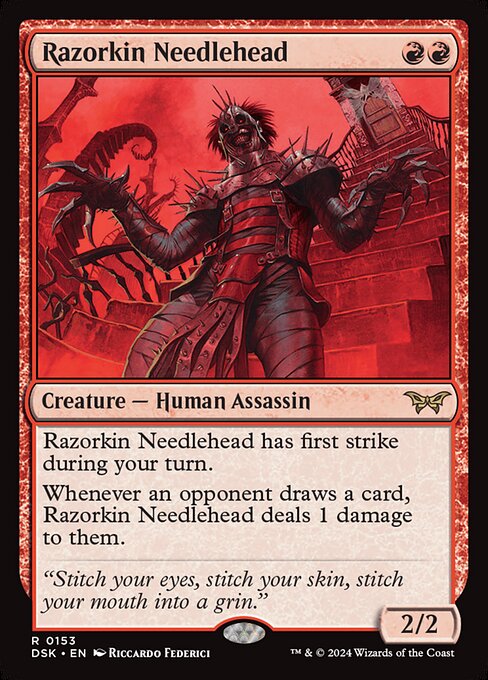
Razorkin Needlehead feels like what Orcish Bowmasters should’ve been—a strong deterrent to mass card draw that isn’t utterly busted or an auto-include in every deck. The problem? It’s so much weaker that I wish it had a bit more punch. It doesn’t need flash or an enter-the-battlefield trigger, but the ability to target creatures would’ve been a nice touch, especially for red decks that can handle two red pips.

As it is, Razorkin Needlehead probably won’t make the cut just to annoy the Rhystic Study player. It’s a bit too clunky for that. However, it does have a clear role in cEDH, particularly in Ob Nixilis, Captive Kingpin decks, where its synergy is more apparent. Otherwise, its lack of versatility will likely keep it on the sidelines.

UNTIMELY MALFUNCTION
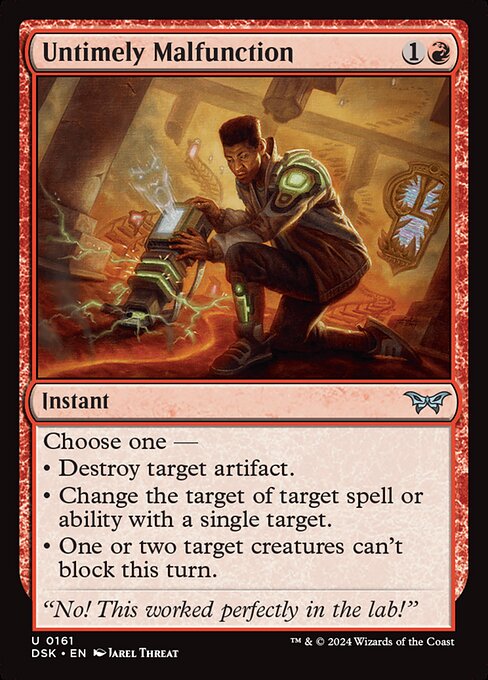
Untimely Malfunction serves as a sidegrade to the cEDH staple Abrade. If you’ve ever played a low-color red deck, you’re probably very familiar with Abrade—its flexibility to either remove a creature or destroy an artifact is always relevant. Most cEDH creatures have three toughness or less, and artifacts are abundant, so Abrade rarely misses. Untimely Malfunction, however, swaps out the artifact removal for the ability to either redirect a spell (in a Deflecting Swat style) or make two creatures unable to block.

While stopping blockers is situational—mainly useful for damage triggers or going for a lethal swing against a low-health player—the real value comes from its ability to redirect a spell. You can throw a Path to Exile or Swords to Plowshares back at its caster, protect a noncreature permanent from removal, or, perhaps most importantly, counter a counterspell by redirecting it to itself. This effect is already available in Deflecting Swat, which is free and therefore strictly better, but Untimely Malfunction is unique in offering this utility alongside creature removal.

Overall, I’d say Untimely Malfunction is slightly weaker than Abrade due to the loss of artifact removal, but if you’re in a low-color deck and need more flexible interaction that can remove a creature or protect one of your own, Untimely Malfunction could be a solid alternative.

VENGEFUL POSSESSION
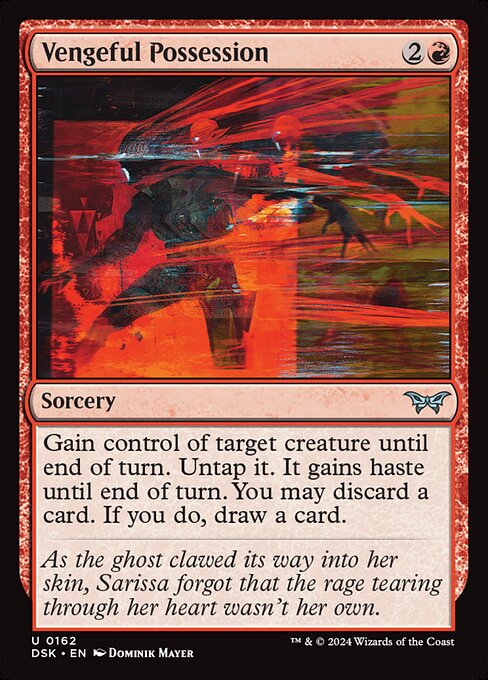
Threaten effects rarely make an impact in cEDH, usually reserved for draft decks—except for one key case: Stella Lee, Wild Card. For Stella, the value in taking control of a creature isn’t the point—you’re always targeting Stella herself. The real appeal of Vengeful Possession lies in the fact that it untaps the creature, enabling Stella’s primary combo of copying herself and untapping in an infinite loop. (For more on this combo, check out the link from our friends at Commander Spellbook.)

What makes Vengeful Possession particularly interesting is that it allows you to draw and discard with each iteration. While this is weaker than similar effects like Crimson Wisps or Cerulean Wisps—since it’s card-neutral rather than card-positive—it still enables you to dig through your deck, helping you find Twisted Fealty, which is the actual win condition. The discard also feeds into Underworld Breach lines, adding an extra layer of synergy.

If you’re curious about playing Stella Lee, Wild Card in cEDH, Josh LeBlanc from ElderDrunkenHighlander has put together a comprehensive writeup on the deck, which is worth checking out for deeper insights.

CONCLUSION

Duskmourn: House of Horrors ranks among the weaker sets I’ve reviewed for cEDH. While I’m excited about Kaito, Bane of Nightmares and expect The Master of Keys to be a hit with reanimation enthusiasts, and Marvin, Murderous Mimic certainly has endless combo potential, there’s just not a lot to sink your teeth into. From a cEDH standpoint, this set feels less like The Exorcist or The Thing and more like Winnie-the-Pooh: Blood and Honey—not great.

But as I always emphasize, that’s perfectly okay! Magic sets aren’t crafted specifically with cEDH in mind, and despite the growing popularity of our quirky little subformat, I believe they shouldn’t have to cater to it. Until next time…

What is MTG’s Commander Damage Rule?

Are you ready to step into the realm of MTG where mighty legends clash, wielding powers beyond imagination? Welcome to the enchanting world of Commander, a format that beckons seasoned players and novices alike with its allure of epic duels and unforgettable encounters. But there’s a particular rule that adds an exciting twist to these battles – the infamous “Commander Damage” rule! So, grab your decks, summon your legendary warriors, and let’s embark on a thrilling journey to understand the heart-pounding essence of Commander Damage.

Imagine a plane where planeswalkers summon their chosen commanders to lead their armies into battle. Each commander possesses extraordinary abilities, representing the essence of their planes and their people. It is a world where strategy and finesse blend seamlessly with raw power, and the mightiest legends often emerge victorious.

The Commander Damage rule adds a dash of danger to these encounters. In the traditional game of Magic: The Gathering, players begin with a life total of 20, but in Commander, it’s an elevated 40. You may think that this means longer battles, but hold your horses! That’s where the twist comes in.

Unlike regular Magic, where losing all your life points spells defeat, Commander Damage introduces an alternate path to demise. If a player is dealt 21 or more combat damage by a single commander throughout the course of the game, they lose instantly! Yes, you read that right – a commander’s personal vendetta can swiftly bring about your downfall.

Picture this: A hulking Minotaur General charges forth from the battlefield, wielding a gigantic battle-axe that gleams with malevolence. His name is Ragehoof, and with each swing of his weapon, he strikes fear into the hearts of his enemies. Ragehoof’s controller, Felicia, has already felt the sting of his blade once before, but her life total is still far from zero. She draws her cards, devises a plan, and rallies her forces for one last push. However, in the blink of an eye, Ragehoof’s fierce assault reduces Felicia’s life to 0, and her dream of victory crumbles like a house of cards.

Commander Damage epitomizes the concept of individual vendettas amidst the grand-scale warfare of Commander. It calls for players to carefully consider their defenses, never letting their guard down against the potential wrath of an opponent’s legendary commander. One careless attack, and you might just find your life total plummeting into the abyss.

But don’t be too hasty to assume that Commander Damage solely favors aggression. Oh no, my friend, it is a delicate dance that demands both caution and audacity. Commanders aren’t indestructible; they can fall in battle just like any other creature. And when that happens, the commander’s controller must decide whether to cast them again, rekindling their fury, or to retreat, preserving their precious life total.

Let’s explore a different scenario: The elegant Faerie Rogue, Ariel, weaves through the battlefield, leaving a trail of enchantment and mischief in her wake. As she flutters towards her opponents, her sparkling laughter bewitches even the most steadfast warriors. She is both elusive and enchanting, embodying the very spirit of her plane.

Her controller, Ethan, has already dealt significant damage to two of his adversaries, but he knows better than to ignore the third. The third foe, Aldric, has a formidable commander named Bloodfire, a fierce dragon that breathes literal fire. One false step, and Bloodfire’s wrath could send Ariel’s life total tumbling down. Ethan must carefully weigh his options: risk facing the wrath of Bloodfire, or dance around the dragon and ensure a slow but steady victory.

Commander Damage Rule

Commander Damage is a rule that resonates with storytelling, for it weaves captivating tales of rivalries and alliances, struggles and triumphs. It encourages players to forge bonds with their commanders, embracing their unique traits and personalities. A commander is not just a card in your deck; it’s a character with a life of its own.

Consider, for instance, a formidable duo: Kalemne, the Worthy, a giant warrior, and Bruse Tarl, Boorish Herder, a grizzled orc. Kalemne wields an enormous warhammer, while Bruse brandishes a cruel whip. They may seem an unlikely pair, but they complement each other perfectly. As they unleash their combined might on the battlefield, opponents cower before their relentless assault. Their story unfolds with every swing, every strike, and every victory.

In Commander, players become narrators, chroniclers of legendary sagas. Each card in their deck is a verse in the grand poem of their commander’s journey. As they play, the narrative unfurls before their eyes, culminating in a climax that often involves the deadly touch of Commander Damage.

The rule also breathes life into the commanders themselves, endowing them with a unique aura of authority. It encourages players to take risks and play fearlessly, because after all, one cannot conquer the realm of Commander with timidity. Instead, they must embrace the courage of their commanders and revel in their unique abilities.

Commander Damage is the whispered secret of a secret society of planeswalkers, passed down from generation to generation. It’s the extra spice in the already sumptuous feast of Commander battles. It reminds players that within every deck, there lies a tale of valor and honor, of perseverance and sacrifice.

Conclusion

In conclusion, the Commander Damage rule in MTG is a powerful element that enriches the Commander format like a masterful brushstroke on a canvas. It adds depth, tension, and excitement to the game, pushing players to explore their strategic limits and embrace the soul of their commanders.

So, next time you engage in a Commander duel, remember the fierce dance of legendary warriors. Embrace the tales woven by your commanders and revel in their might. For within the heart of Commander Damage lies the soul of a true planeswalker, ready to face any challenge, forge any alliance, and etch its name in the annals of MTG history. Now, summon your commanders, for the battleground awaits, and the world of Commander calls out to the bravest of hearts!

Understanding Color Identity in EDH

In the world of Magic: The Gathering, the Commander format, also known as EDH (Elder Dragon Highlander), offers a unique and exciting way to play the game. One of the fundamental aspects of EDH is the concept of color identity. Understanding how color identity works is essential for constructing a well-balanced and synergistic Commander deck. In this article, we will delve into the intricacies of color identity, exploring its significance, limitations, and how it shapes the gameplay experience.

What is EDH?

EDH or Elder Dragon Highlander, is a multiplayer format of Magic: The Gathering. It revolves around the use of a legendary creature called the Commander, which acts as the deck’s centerpiece and represents the player’s avatar in the game. Each Commander has a specific color identity that determines the colors of mana symbols present in the deck.

The Basics of Color Identity

basics of color identity in edh

Defining Color Identity

Color identity in EDH refers to the combination of colors present in a card’s casting cost, rules text, and color indicators. This includes both the mana symbols and the colorless mana symbols. A card’s color identity is determined by all these factors, not just the colors of mana it produces. For example, if a card has a red mana symbol in its casting cost but produces colorless mana, its color identity is still red.

Commanders and Their Color Identity

The color identity of a Commander is crucial in deck construction. The color identity of your Commander dictates which cards you can include in your deck. You are only allowed to include cards that share a color or are colorless in your Commander’s color identity. This means that if your Commander has a red and white color identity, you can include red, white, colorless cards, and cards with hybrid mana symbols that are either red or white.

Deck Construction Guidelines

Color Identity Restrictions

When building an EDH deck, it is essential to adhere to the color identity restrictions. You must only include cards that match the color identity of your Commander. This restriction ensures that each deck is thematically cohesive and prevents players from accessing the full range of cards available in the game.

Including Multicolored Cards

While the color identity of your Commander restricts the cards you can include, you can still use multicolored cards as long as the colors in their casting cost match your Commander’s color identity. Multicolored cards can provide additional flexibility and power to your deck, enabling unique synergies and strategies.

The Influence of Color Identity on Gameplay

Mana Generation and Card Selection

Color identity directly affects your deck’s mana base and the availability of different colors of mana. The colors present in your deck determine the types of lands and mana sources you need to include. Proper mana generation is crucial for casting spells and activating abilities that match your deck’s color identity.

Synergies and Strategies

The color identity of your Commander and deck greatly impacts your chosen synergies and strategies. Each color in Magic: The Gathering has its strengths, weaknesses, and unique mechanics. Understanding the strengths and weaknesses of different colors allows you to build a deck that exploits synergies and maximizes your chances of victory.

Interaction with Other Players

Color identity also plays a significant role in the interaction between players during the game. Each color offers distinct ways of disrupting opponents’ strategies and protecting your own. The interplay between different colors creates dynamic and engaging gameplay, where players must adapt their strategies to counter their opponents effectively.

Exploring the Five Colors of Magic

colors of magic, five colors of magic, edh

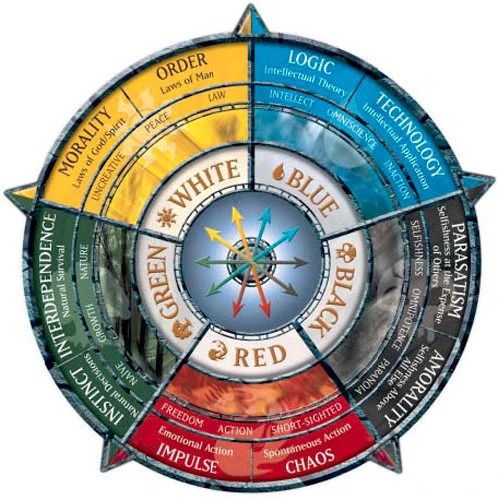
Magic: The Gathering features five colors: white, blue, black, red, and green. Each color represents different philosophies, abilities, and playstyles. Let’s take a brief look at each color and their characteristics:

White: The Color of Order and Protection

White emphasizes order, healing, protection, and the ability to generate small creatures quickly. It excels at removing threats, gaining life, and establishing a defensive position.

Blue: The Color of Intellect and Manipulation

Blue represents intellect, control, card draw, and counterspells. It excels at manipulating the game through card advantage, countermagic, and bouncing permanents.

Black: The Color of Ambition and Power

Black embodies ambition, power, sacrifice, and manipulation of life and death. It excels at destroying creatures, reanimating creatures from graveyards, and exploiting resources.

Red: The Color of Emotion and Chaos

Red embodies emotion, chaos, aggression, and quick bursts of damage. It excels at direct damage, haste, temporary creature control, and chaotic effects.

Green: The Color of Nature and Growth

Green represents nature, growth, ramping, and large creatures. It excels at accelerating mana, searching for lands, and playing massive creatures earlier than other colors.

Color Identity in Deck Archetypes

Understanding color identity is crucial for constructing different deck archetypes in EDH. Here are some common archetypes and how color identity influences them:

Aggro

Aggressive decks focus on quickly reducing opponents’ life totals. The color identity determines the types of creatures, combat tricks, and direct damage spells available to the deck.

Control

Control decks aim to dominate the game by countering spells, removing threats, and grinding opponents’ resources. The color identity determines the range of counterspells, removal spells, and card draw options.

Combo

Combo decks seek to assemble specific combinations of cards to achieve a powerful win condition. Color identity determines the available combo pieces, tutors, and protection spells.

Midrange

Midrange decks aim to strike a balance between aggression and control. Color identity determines the types of threats, answers, and card advantage engines available to the deck.

Voltron

Voltron decks focus on suiting up a single creature with powerful equipment and auras. Color identity influences the selection of creature types, equipment, and auras available.

Adapting and Evolving Your Deck

As you play with your Commander deck, you might discover the need to adapt and evolve it over time. Here are a couple of considerations:

Expanding Your Color Identity

If you feel that your deck lacks certain abilities or strategies, you can consider changing your Commander to include additional colors in its color identity. This opens up new possibilities for card selection and synergies.

Adjusting the Mana Base

As you add or remove colors from your deck, you’ll need to adjust the mana base accordingly. Ensuring a balanced distribution of lands and mana sources is crucial for consistent performance.

Conclusion

Understanding how color identity works is essential for building and playing Commander decks effectively in the EDH format. It dictates the cards you can include, influences your gameplay decisions, and offers a diverse range of strategies and synergies. By harnessing the strengths of different colors and adapting your deck to fit your playstyle, you can create a unique and powerful Commander deck that represents your own color identity.

Top 5 Best Cards in MTG Commander

Commander, also known as Elder Dragon Highlander or EDH for short, is a unique and exciting format in Magic: The Gathering. With a vast card pool and a multiplayer focus, it demands a strategic approach to deck-building and gameplay. In Commander, players construct decks with a minimum of 100 cards, led by a legendary creature or planeswalker known as their “COMMANDER”.

Each deck is built around a specific color identity, which consists of the mana symbols present in the casting costs and rules text of the commander. This format encourages creativity, allowing players to explore synergies among thousands of cards and build decks that reflect their personal style and strategies.

The multiplayer aspect of Commander sets it apart from other MTG formats. The game typically involve four or more players, each starting with 40 life points, adding a social dynamic to the gameplay. The increased number of opponents introduces unique challenges and opportunities, as players must navigate alliances, politics, and threats from multiple angles.

Commander decks often focus on long-term strategy and the accumulation of resources. With a starting hand size of seven and the ability to draw an additional card each turn, card advantage and card selection play a crucial role. The larger deck size also means that redundancy and consistency become essential factors to consider when constructing a powerful and resilient deck.

The format’s popularity has resulted in a vast and diverse metagame, with countless themes, archetypes, and strategies represented. From tribal decks centered around specific creature types to combo decks aiming for game-ending interactions, Commander offers a wide range of playstyles and experiences.

In this article, we will dive into the realm of Commander and explore the top 5 best Commander cards. These cards have proven their worth time and time again, earning their place in the hearts and decks of many Commander players.

5. Streets of New Capenna Triomes

The completion of the Triome cycle has been eagerly awaited for a few years. Now, with the introduction of the Shard Triomes in Streets of New Capenna, we finally have a Triome for each three-color combination!

For those unfamiliar, the Triomes unveiled in New Capenna include Raffine’s Tower, Spara’s Headquarters, Ziatora’s Proving Ground, Jetmir’s Garden, and Xander’s Lounge. These Triomes aptly represent the Esper, Bant, Jund, Naya, and Grixis Shard colors, respectively.

The significance of Triomes extends beyond being fetchable sources that tap for three colors. They possess the additional ability to be cycled for three mana. This allows you to potentially find more valuable cards if you happen to draw them later in the game. While the cycling ability may not be exceptionally powerful, it does introduce utility to your land base, which is always advantageous.

The completion of the Triome cycle brings a new level of versatility and options to deck-building, particularly in three-color combinations. Whether used for their multicolored mana generation or the ability to cycle for card selection, the inclusion of Triomes in your land base is undeniably beneficial.

4. Farewell

Ladies and gentlemen, prepare yourselves for what might just be the ultimate board wipe in the entire Commander format. Farewell, while a bit pricier compared to more specific options, offers a unique and customizable board wipe experience that can essentially reset the game.

The sheer power of Farewell stems from its ability to exile everything you choose to target. This bypasses the resilience of Indestructible cards, which are surprisingly common in the format. By exiling your selected targets, Farewell ensures that even the toughest threats are permanently removed.

Moreover, Farewell provides an array of versatile modes for you to select from. With the ability to exile creatures, artifacts, enchantments, and graveyards, Farewell becomes a solution to virtually any non-Planeswalker dominated board state. This flexibility renders it capable of neutralizing numerous common strategies seen in the format.

The remarkable prominence of Farewell in the Commander format is evident in its substantial play rate. Currently, it boasts an impressive 13% inclusion across all decks on the EDHREC platform, solidifying its position as one of the most widely-played cards in the format.

3. Black Market Connections

Black Market Connections, a three-mana enchantment, has proven to be on par with Commander staples like Smothering Tithe. Initially overlooked, this card gained significant recognition after an impressive performance on the Command Zone. As a result, its price skyrocketed over a few months, solidifying its position as one of the most powerful options in the entire Commander format.

Black Market Connections presents a combination of card draw, mana advantage, and a creature body. However, there’s a catch: you must pay life based on your desires. Each of these abilities can be activated separately, allowing flexibility in choosing which modes to utilize each turn. Nevertheless, when playing Black Market Connections, the goal is often to leverage multiple modes simultaneously. While cards like Phyrexian Arena offer card draw at a more favorable rate, paying three life for an additional card and a Treasure Token on every turn undeniably delivers a more substantial impact. Should you consistently utilize all three abilities, you will find yourself paying seven life per turn. Although this may not seem significant in the context of Commander, it can quickly accumulate if not managed carefully.

2. Displacer Kitten

If Displacer Kitten and Paradox Engine were released simultaneously, it’s highly likely that both cards would have faced bans in the Commander format. However, with the advent of the Rule Zero concept deeply ingrained in the community, the need for numerous bans has been alleviated. This fact alone solidifies its contention for the second spot on our list.

Displacer Kitten, deceptively concealed behind its adorable feline appearance, is a ruthless combo piece. The intricacies of its combos are extensive, but they essentially revolve around utilizing Displacer Kitten’s abilities to blink mana rocks and trigger enter-the-battlefield effects, paving the way for a victorious outcome from various starting points.

In many deck builds, Displacer Kitten often falls outside the scope of Rule Zero discussions, making it a surprising inclusion in approximately 5% of decks, according to EDHREC’s play rate statistics. Its potency as a combo enabler remains undeniable, even with the nuances of deck customization and social agreement within the Commander format.

1. Boseiju, Who Endures

Boseiju, Who Endures, holds the prestigious number one spot on our list and has undeniably revolutionized the way Magic is played across multiple formats. Its immense influence solidifies its position at the top without question.

In the Commander format, Boseiju stands out as a cut above the other Channel Lands. While it remains exceptional in other formats as well, its significance is particularly pronounced in Commander. Given the format’s emphasis on powerful artifacts and enchantments, having a utility land that can destroy them is a significant advantage over a mere Basic Forest.

Notably, Boseiju is yet another card that Archivist of Oghma can transform into a cantrip, amplifying its versatility. Its ability to annihilate targets in a manner that’s challenging to interact with renders traditional countermagic useless against it. Ultimately, the unparalleled freedom and flexibility that Boseiju grants to all green decks in the Commander format establish it as the paramount MTG Commander card.